Jet Propulsion and the Tsiolkovsky Rocket Equation
A rocket speeds up by throwing out hot gas: it pushes off neither the air nor the ground but its own exhaust. Launch it in open space or from the pad, watch the fuel run down and the speed grow — and catch the moment the rocket outruns its own gas. In space the momentum of the rocket and the momentum of the ejected gas always add up to zero.
The calculation is exact: the motion is given by formulas of time, and the moments of impact, shot, lift-off and burnout are found from equations, so the numbers match the formulas and do not depend on the playback speed. The impact and the shot are instantaneous, there is no air drag, g = 9.8 m/s².
The rocket launches from the Earth: with u = 3 km/s and m₀/m = 5 it reaches 4.04 km/s at burnout (80 s) — 0.78 km/s less than u·ln 5 ≈ 4.83 km/s. The difference is the gravity loss gt = 9.8·80 = 784 m/s. Make the burn long (300 s): the thrust becomes less than the weight, and the rocket stands on the pad until it has burnt part of its fuel. Then switch to space: there the final speed is exactly u·ln(m₀/m) and does not depend on the burn time. And try to bring a single stage to the first cosmic velocity of 7.9 km/s.
KEY FORMULAS
Conservation of momentum
In a closed system the total momentum before an interaction equals the total after it
Thrust
μ is the mass flow rate (gas mass per second), u the gas speed relative to the rocket
Tsiolkovsky rocket equation
m₀ is the initial mass, m the current mass; the second form is a vertical launch with constant g, lifting off at t = 0
Velocity of the centre of mass
With no external forces the centre of mass of a system moves uniformly in a straight line
How a rocket moves. A rocket throws gas backwards at a speed u relative to itself. By conservation of momentum the gas carries momentum backwards, and the rocket gets the same momentum forwards: every second the engine ejects a mass μ and creates a thrust F = μu. No support is needed, so a rocket accelerates in empty space as well — where a propeller or a wheel has nothing to push against.
The Tsiolkovsky equation. Let a rocket of mass m throw out a portion of gas dm. The momentum of the system is conserved: m·dv = u·dm, so dv = u·dm/m. Adding up such steps while the mass falls from m₀ to m gives v = u·ln(m₀/m). The speed depends only on the exhaust speed and the mass ratio, not on how fast the fuel burns: a long burn gives the same speed, just with a smaller acceleration.
The rocket outruns its gas. At m₀/m = e ≈ 2.72 the rocket's speed equals u. Beyond that the rocket flies faster than its own exhaust, and the gas just thrown out (its speed relative to the launch point is v − u) already moves forward, following the rocket. To reach 7.9 km/s with u = 3 km/s you need m₀/m ≈ 14: 93 % of the initial mass is fuel. That is why rockets have stages and drop their empty tanks.
Launch from the Earth. On the Earth gravity pulls the rocket down: v = u·ln(m₀/m) − gt, and the longer the engine burns, the larger the “gravity losses” gt. If the thrust is less than the weight (μu < m₀g), the rocket stands on the pad until its mass drops to F/g — lift-off happens at tlo = (m₀ − F/g)/μ. After burnout the rocket coasts upwards and slows down to the height H = hf + vf²/(2g).
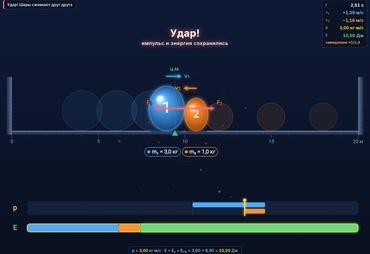
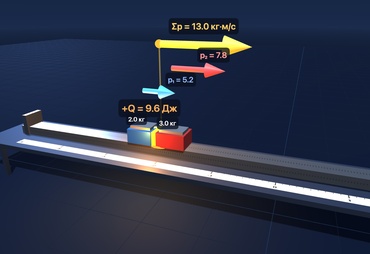
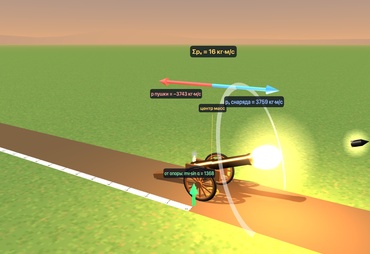
The same law works in cannon recoil — a single “shot” instead of a continuous jet — and in an inelastic collision. The model is ideal: m₀ = 100 t, constant g = 9.8 m/s², no air drag, vertical flight.
First come simulators and problems from this very chapter, then closely related topics of the section.
 Same topic
 Same topic
 Same topic
 Same topic
 Mechanics · Motion
 Mechanics · Energy