Cannon Recoil: Conservation of Momentum
A cannon fires a shell — and rolls back. In slow motion you can see that the horizontal momenta of the shell and the cannon are equal and opposite, Σpₓ = 0, while their energies differ by tens of times. Raise the barrel, change the masses and friction, and measure the recoil distance with the ruler.
The calculation is exact: the motion is given by formulas of time, and the moments of impact, shot, lift-off and burnout are found from equations, so the numbers match the formulas and do not depend on the playback speed. The impact and the shot are instantaneous, there is no air drag, g = 9.8 m/s².
Start with the textbook problem: an 800 kg cannon fires a 10 kg shell horizontally at 400 m/s — the recoil speed is V = mv/M = 5 m/s. Raise the barrel to 45° and 60°: the recoil gets weaker, because only the horizontal part of the momentum is conserved. Pick “Shell as heavy as the cannon” — the recoil becomes as fast as the shot. And on ice (μ = 0) the cannon never stops.
KEY FORMULAS
Conservation of momentum
In a closed system the total momentum before an interaction equals the total after it
Cannon recoil
v is the shell's speed relative to the ground, α the barrel angle; s is the recoil distance with friction μ
Velocity of the centre of mass
With no external forces the centre of mass of a system moves uniformly in a straight line
The energy of a shot is split unequally
The momenta of the shell and the cannon are equal, while energy is inversely proportional to mass
Why the cannon recoils. Before the shot the cannon and the shell are at rest, their total momentum is zero. The powder gases push the shell forward and the cannon back, and these forces are equal (Newton's third law). The shot lasts thousandths of a second; during that time the friction of the wheels is negligible compared with the gas pressure, so the horizontal momentum of the system is conserved: mv·cos α − MV = 0, which gives V = mv·cos α / M. Here v is the shell's speed relative to the ground.
A raised barrel. The vertical component of the shell's momentum mv·sin α is not conserved: at the moment of the shot the cannon is pressed into the ground, and the Earth answers with the impulse of the normal force (the green arrow at the wheels). So the steeper the barrel, the weaker the recoil: at 60° it is half as strong as in a horizontal shot.
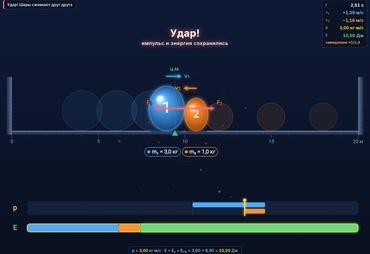
Equal momenta, unequal energies. Energy can be written through momentum: E = p²/(2m). With equal momenta the light shell gets M/m times more energy than the heavy cannon (M/(m·cos²α) times at an angle α). That is why the shell is dangerous, not the recoil, and why a rifle is pressed to the shoulder — to “add” the shooter's mass to it.
After the shot. Friction slows the cannon down with acceleration μg, and it stops after a distance s = V²/(2μg) in a time V/(μg). Now an external force acts on the system, so Σpₓ starts to grow — the cannon's momentum goes into the Earth. The centre of mass of 'cannon + shell' stays put at the moment of the shot and moves only because of external forces: friction and the shell hitting the ground.
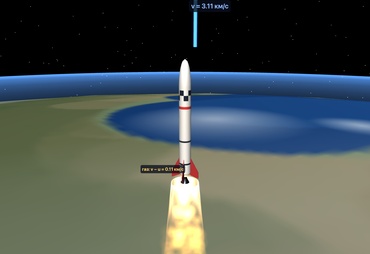
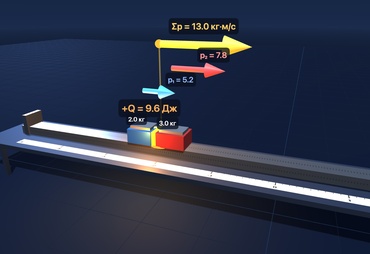
Where else. The kick of a rifle, the jerk of a fire hose, a boat that a person jumps off — it is all the same law. Fire gas continuously and you get rocket jet propulsion; if the bodies stick together instead of flying apart, it is an inelastic collision. The model is ideal: an instantaneous shot, no air drag, g = 9.8 m/s².
First come simulators and problems from this very chapter, then closely related topics of the section.
 Same topic
 Same topic
 Same topic
 Same topic
 Mechanics · Motion
 Mechanics · Energy