Projectile Motion: Launch at an Angle
Fire the cannon and see why the body flies along a parabola. Its motion is made of two simple ones: horizontally it moves at a constant speed, while vertically it slows down and speeds up like a ball thrown straight up. Shadows on the axes and a strobe make this visible, and the numbers on the display match the textbook formulas.
Motion graphs
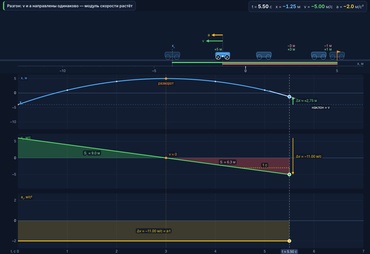
The dashed line is the whole flight from the formulas, the solid line is drawn together with the body. Compare: vₓ stays the same, while vᵧ decreases steadily and passes through zero at the top.
Air resistance is ignored (except for the orange ball); the body is launched from height h₀ above flat ground. Position and velocity come from the exact formulas, so the numbers on the screen match the textbook.
The key idea in short: a launched body takes part in two motions at once. Horizontally it moves uniformly — vₓ = v₀·cos θ does not change. Vertically it moves with constant acceleration g, like a ball tossed straight up. Together these two motions make a parabola. Example: v₀ = 20 m/s, θ = 30° — the body rises 5.1 m and lands after 2.04 s, 35.4 m from the cannon. Set these numbers and check.
See also
KEY FORMULAS
Components of the initial velocity
The initial velocity is split into horizontal and vertical parts. θ is the angle between the velocity vector and the horizontal.
Horizontally — uniform motion
No force acts on the body horizontally, so the horizontal velocity does not change during the whole flight.
Vertically — uniformly accelerated motion
The vertical velocity decreases by g every second: vertically the body moves just like one thrown straight up. h₀ is the launch height.
Rise time and maximum height
At the top the vertical velocity is zero. The height depends only on the vertical component of the initial velocity.
Flight time (launch from the ground)
If the body is launched from the ground and lands at the same level, the rise and the fall take the same time, so T = 2t₁.
Range (launch from the ground)
The range is the horizontal speed times the flight time. It is largest at 45°; the angles θ and 90° − θ give the same range.
Equation of the path — a parabola
Expressing the time from x(t) and substituting it into y(t) gives y as a quadratic function of x — a downward-opening parabola.
Launch from a height h₀
The flight time is the positive root of y(T) = 0. In a horizontal launch (θ = 0) T = √(2h₀/g), the same as for a body simply dropped.
Speed at any point of the path
The speed depends only on the height above the launch point. α is the angle the velocity vector makes with the horizontal at that moment.
What projectile motion is. A body is launched with speed v₀ at an angle θ to the horizontal, and after that only gravity acts on it. Air resistance is neglected. Then the acceleration of the body is always the same: a = g ≈ 9.8 m/s², pointing straight down. This is true on the way up, at the top and on the way down. A stone, a ball, a jet of water from a hose and a cannonball all move like this. The path of such a motion is a parabola.
Two motions instead of one. The key idea, noticed by Galileo: horizontal and vertical motion do not interfere with each other. The initial velocity is split into two components: v₀ₓ = v₀·cos θ and v₀ᵧ = v₀·sin θ. No force acts horizontally, so vₓ = v₀ₓ stays constant and x = v₀ₓ·t. This is uniform motion. Gravity acts vertically, so vᵧ = v₀ᵧ − g·t and y = h₀ + v₀ᵧ·t − g·t²/2. This is uniformly accelerated motion, exactly like that of a body thrown straight up at speed v₀ᵧ. In the simulator you can see it in the shadows: the blue shadow on the ground covers equal distances in equal Δt, while the green shadow on the y-axis rises more and more slowly, stops and falls faster and faster.
Velocity during the flight. The velocity vector always points along the tangent to the path. Its horizontal part vₓ does not change, while the vertical part vᵧ decreases by 9.8 m/s every second. At the top vᵧ = 0, but the velocity itself is not zero: the body keeps flying forward at speed vₓ. This is the smallest speed of the whole flight. With h₀ = 0 the body hits the ground with the same speed v₀ it was launched with and at the same angle θ, only pointing down. The speed at any point is v = √(vₓ² + vᵧ²) = √(v₀² − 2g(y − h₀)). It depends only on the height, not on whether the body is going up or down.
Height, time and range. The rise time follows from vᵧ = 0: t₁ = v₀·sin θ / g. The maximum height is H = v₀²·sin²θ / (2g). For a launch from the ground the rise and the fall take the same time, so the total flight time is T = 2v₀·sin θ / g. The range is the horizontal speed times the flight time: L = v₀ₓ·T = v₀²·sin 2θ / g. Example: v₀ = 20 m/s, θ = 30°. Then v₀ₓ = 17.32 m/s, v₀ᵧ = 10 m/s, t₁ = 1.02 s, H = 5.10 m, T = 2.04 s, L = 35.35 m. Set these values in the simulator and check every number in the Measurements panel.
Why 45°. The range formula contains sin 2θ, which is largest when 2θ = 90°, that is θ = 45°. Then Lmax = v₀²/g. Angles that add up to 90° (30° and 60°, 15° and 75°) give the same range, because sin 60° = sin 120°. But at the larger angle the body flies higher and longer. You can see it on the right-hand graph below the scene: the curve L(θ) is symmetric about 45°. If you launch from a height h₀, the best angle becomes smaller than 45°: from a 10 m tower at v₀ = 20 m/s the best angle is 39.3°, and the body flies 49.8 m instead of 40.8 m from the ground.
Launch from a height and horizontal launch. If the body is launched from a height h₀, the flight time follows from the equation y(T) = 0: T = (v₀ᵧ + √(v₀ᵧ² + 2gh₀))/g, and the range is still L = v₀ₓ·T. The formula L = v₀²·sin 2θ / g no longer works here. In a horizontal launch (θ = 0) there is no vertical velocity at the start, and the body falls for exactly as long as it would if it were simply dropped: T = √(2h₀/g). From 20 m that is 2.02 s for any horizontal speed. Check it with the “Throw vs drop” experiment.
Other planets and air. Every formula has g in the denominator. On the Moon g = 1.62 m/s², six times less than on Earth, so a body launched at the same speed flies six times higher and six times farther. On Jupiter (g = 24.8 m/s²) it is the other way round: 2.5 times shorter. In real air a ball does not follow a parabola: drag takes away its speed, the path becomes steeper on the way down, and the range is noticeably shorter. A football kicked at 25 m/s at 45° would fly 63.8 m in a vacuum but only about 40 m in air. Its best angle is no longer 45° but about 41–43°. Turn on “Compare with a ball in air” and look at the orange curve.
Common mistakes in problems. Thinking that the speed at the top is zero, when only vᵧ is zero. Thinking that the acceleration disappears at the top, when it is equal to g all the time. Mixing up sine and cosine: the horizontal component is v₀·cos θ, the vertical one v₀·sin θ (the angle is measured from the horizontal). Using T = 2v₀·sin θ / g and L = v₀²·sin 2θ / g for a launch from a height. Forgetting that the horizontal speed does not affect the fall time.
How the simulator works. The position and velocity of the body are calculated from the exact formulas x(t) and y(t), not approximately frame by frame, so the numbers on the display match the textbook to the last digit and do not depend on the playback speed. The moments of the top point and of landing are computed exactly. The flight of the ball in air (mass 0.43 kg, diameter 22 cm) is computed numerically with the fourth-order Runge–Kutta method. Smoke, sparks and dust are decoration only and do not affect the calculation. On Earth g is taken as 9.8 m/s².
First come simulators and problems from this very chapter, then closely related topics of the section.
 Same topic
 Mechanics · Energy
 Mechanics · Energy
 Mechanics · Momentum
 Mechanics · Circular Motion
 Mechanics · Hydrostatics