Inelastic Collision: Conservation of Momentum
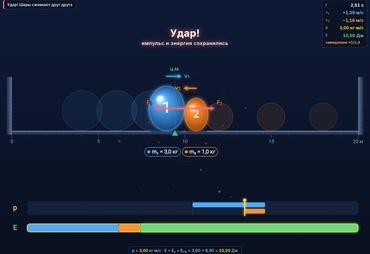
Two carts on an air track collide and stick together. The blue and red arrows are the momenta of the carts, the golden one is their sum Σp: in the impact the single momenta change, but the sum stays the same. See how much kinetic energy turns into heat and why the centre of mass moves just as it did before the impact.
The calculation is exact: the motion is given by formulas of time, and the moments of impact, shot, lift-off and burnout are found from equations, so the numbers match the formulas and do not depend on the playback speed. The impact and the shot are instantaneous, there is no air drag, g = 9.8 m/s².
Start with the textbook problem: a 3 kg cart moving at 4 m/s hits a 2 kg cart coming the other way at 6 m/s. The momenta are equal and opposite, Σp = 0, so after the impact the carts stop dead and all 60 J of kinetic energy becomes heat. Then pick “Bullet into a block”: when a light, fast body hits, 91 % of the energy becomes heat. And switch the collision to elastic — momentum is conserved the same way, but there is no heat.
KEY FORMULAS
Conservation of momentum
In a closed system the total momentum before an interaction equals the total after it
Perfectly inelastic collision
The bodies stick together and move as one; v₁, v₂ are signed velocity components
Energy turned into heat
Kinetic energy decreases in an inelastic collision; the loss depends only on the relative velocity
For comparison: elastic collision
Both momentum and kinetic energy are conserved; Q = 0
Velocity of the centre of mass
With no external forces the centre of mass of a system moves uniformly in a straight line
Momentum and a closed system. The momentum of a body p = mv is a vector pointing along the velocity. If no external forces act on a system (or they balance, like gravity and the reaction of a smooth track), its total momentum does not change: m₁v₁ + m₂v₂ = m₁v₁′ + m₂v₂′. In the impact the carts push each other with equal and opposite forces for the same time (Newton's third law), so whatever momentum one cart gains, the other loses.
Perfectly inelastic collision. The bodies stick together and move on with a common velocity v = (m₁v₁ + m₂v₂)/(m₁ + m₂). Velocities are signed: motion the other way gets a minus sign. Momentum is conserved, kinetic energy is not: the part Q = m₁m₂(v₁ − v₂)²/(2(m₁ + m₂)) goes into deforming the plasticine and heating it. If the target is at rest, the fraction m₂/(m₁ + m₂) of the energy is lost: a bullet stuck in a block gives almost all its energy to heat, while a heavy body hitting a light one loses little.
Compared with an elastic collision. Replace the plasticine with a spring bumper and the impact becomes elastic: both momentum and energy are conserved, and the bodies fly apart. Identical carts simply swap velocities. The main lesson: momentum is conserved in any collision, mechanical energy only in an elastic one.
Centre of mass. The velocity of the centre of mass is vc = Σp/Σm. Since Σp does not change, the centre of mass (the golden marker) glides at the same speed before and after the impact, and the stuck carts move exactly with it. When Σp = 0, the centre of mass stands still — and after the impact the bodies stop.
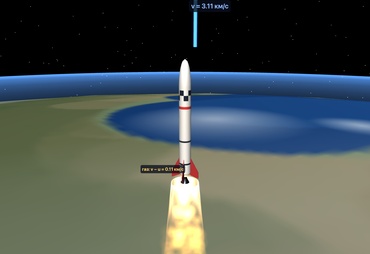
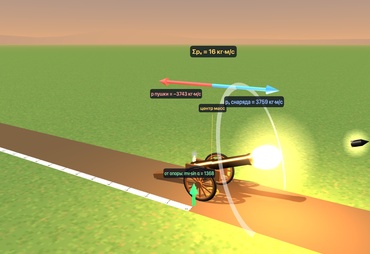
Things to try. Choose speeds that make Σp = 0. Compare “Bullet into a block” and “Heavy into light” on the energy bars under the scene. The same law explains cannon recoil and rocket jet propulsion. The model is ideal: a frictionless track and an instantaneous impact.
First come simulators and problems from this very chapter, then closely related topics of the section.
 Same topic
 Same topic
 Same topic
 Same topic
 Mechanics · Motion
 Mechanics · Energy