Hydraulic Press
Work the pump of a hydraulic jack and lift a car with one hand — or crush an egg, a walnut, a can and even a brick. The colour of the oil shows the pressure: during the down-stroke it is the same in both cylinders, and that is Pascal's law. The gauges, the stroke counter and the bars below the scene show the 'golden rule' of mechanics: what you gain in force you lose in distance, by the same factor.
The colour of the liquid shows the pressure (scale at the bottom left). Force arrows are not to scale (∝ ∛F); the numbers are exact.
Press: oil is incompressible, so S₁h₁ = S₂h₂, and during the down-stroke the pressure is the same in both cylinders (Pascal's law). The weight of the oil column (≈ 3 kPa) is small compared with the pressure in the press and is neglected. The numbers do not depend on the playback speed.
In his Treatise on the Equilibrium of Liquids (published in 1663) Blaise Pascal described a 'new machine for multiplying forces': a vessel with two pistons, one a hundred times larger than the other. One man pushing the small piston balances a hundred men pushing the large one. A working hydraulic press was built by the Englishman Joseph Bramah in 1795. The hard part was not the idea but the seal: under high pressure the water leaked past the piston. The solution was a leather cup that the pressure itself pushes against the cylinder wall — the higher the pressure, the tighter the seal. Jacks, car brakes, excavator buckets, garage lifts and the presses that stamp car bodies all work on the same principle today.
KEY FORMULAS
Pressure
F is the force acting perpendicular to the surface, N; S is the area of the surface, m²; p is the pressure, Pa (1 Pa = 1 N/m²)
Pascal's law
Δp is the extra pressure created by the piston (Pa); A and B are any points in the liquid
Force gain of a hydraulic press
F₁, S₁ are the force on and area of the small piston; F₂, S₂ are those of the big piston
The 'golden rule': loss in distance
h₁ is the distance moved by the small piston, h₂ by the big piston, m; F₁h₁ and F₂h₂ are the work done, J
Pressure. Pressure is the force acting perpendicular to a surface divided by the area of that surface: p = F/S. Its unit is the pascal: 1 Pa = 1 N/m². The same force presses harder on a smaller area. In the press the hand pushes a small piston, so even a modest force creates a large pressure in the oil: 300 N on 4 cm² is 750 kPa, seven and a half times atmospheric pressure.
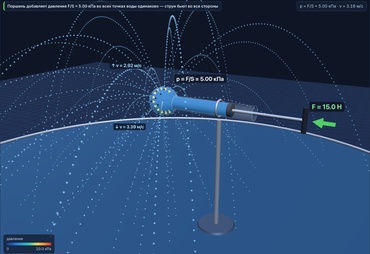
Pascal's law in the press. Pressure applied to a liquid is transmitted unchanged to every point of it. So the pressure created by the hand in the small cylinder is the same under the big piston. In the simulator you can see it in the colour of the oil: during the down-stroke both cylinders have the same colour, and the gauges p₁ and p₂ read the same number.
Force gain. Since the pressure under the pistons is the same, F₁/S₁ = F₂/S₂, and the force on the big piston is F₂ = F₁·S₂/S₁. The press multiplies force by the ratio of the big piston's area to the small one's. With S₁ = 4 cm² and S₂ = 200 cm² the gain is 50: a 300 N push produces 15 kN — enough to lift a 1.5-tonne car (its weight is 14.7 kN). Compare areas, not diameters: a piston with twice the diameter has four times the area.
How a jack works. A real jack is a pump with two check valves. On the down-stroke valve K2 lets oil from the small cylinder into the big one — at that moment the cylinders are connected, exactly like the textbook press. On the up-stroke K2 closes and holds the load while the small cylinder draws oil from the tank through valve K1. The release valve K3 lets the oil back into the tank, and the load goes down smoothly. The p(t) graph shows the valves at work: on the down-stroke the pressures in the cylinders are equal, on the up-stroke the pressure in the small cylinder drops to zero while the big one keeps it.
The 'golden rule' of mechanics. Oil is practically incompressible, so the volume that leaves the small cylinder arrives in the big one: S₁h₁ = S₂h₂. The big piston moves a distance as many times smaller as the force is larger: one 15 cm stroke of the hand lifts the car by only 3 mm. Lifting it by 12 cm takes 40 strokes, and the hand travels 6 m. The work done by the hand equals the work done by the oil on the big piston: F₁h₁ = F₂h₂. A press gives no gain in work — the Force, Distance and Work bars below the scene show this at a glance.
Try it yourself. Set the hand force to 200 N and try to lift the car — the press stops, and the hint tells you how much force is missing. Increase S₂ and watch the force gain grow while the load rises more slowly. Choose the brick: it withstands about 78 kN, and to crush it with a 300 N push you need an area ratio above 260. The egg has a catch: with S₂/S₁ = 2 a 50 N push will not crush it — part of F₂ goes into holding up the platform itself, which weighs about 59 N.
First come simulators and problems from this very chapter, then closely related topics of the section.
 Same topic
 Same topic
 Same topic
 Mechanics · Motion
 Mechanics · Energy
 Mechanics · Energy