Force on a charge at the right angle from two charges
Positive point charges $q_1 = 12$ nC and $q_2 = 16$ nC are placed at vertices $A$ and $B$ of a right triangle $ABC$ with the right angle at $C$ and equal legs $CA = CB = a = 6$ cm. A positive point charge $q_0 = 1$ nC is placed at vertex $C$ (see the figure). Find the magnitude of the force acting on the charge $q_0$.
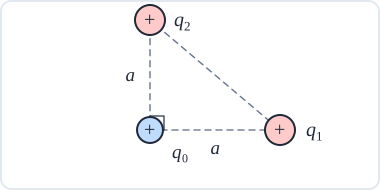
- $q_1 = 12$ nC $= 12 \cdot 10^{-9}$ C
- $q_2 = 16$ nC $= 16 \cdot 10^{-9}$ C
- $q_0 = 1$ nC $= 10^{-9}$ C
- $a = 6$ cm $= 0.06$ m
- $k = 9 \cdot 10^9$ N·m²/C²
- $F = ?$
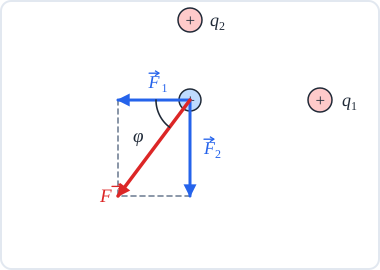
By the superposition principle the force on $q_0$ is the vector sum of the forces $\vec F_1$ and $\vec F_2$ from each charge. All the charges are positive, so the forces are repulsive: $\vec F_1$ points along $AC$ away from $q_1$, $\vec F_2$ along $BC$ away from $q_2$. These forces are perpendicular.
1. Magnitudes from Coulomb's law:
$$F_1 = k\frac{q_0 q_1}{a^2} = 9 \cdot 10^9 \cdot \frac{10^{-9} \cdot 12 \cdot 10^{-9}}{0.06^2} = 3 \cdot 10^{-5} \text{ N}$$$$F_2 = k\frac{q_0 q_2}{a^2} = 9 \cdot 10^9 \cdot \frac{10^{-9} \cdot 16 \cdot 10^{-9}}{0.06^2} = 4 \cdot 10^{-5} \text{ N}$$2. Add the perpendicular vectors with the Pythagorean theorem:
$$F = \sqrt{F_1^2 + F_2^2} = \sqrt{(3\cdot10^{-5})^2 + (4\cdot10^{-5})^2} = 5 \cdot 10^{-5} \text{ N} = 50\ \mu\text{N}$$Direction: $\tan\varphi = F_2/F_1 = 4/3$, so $\varphi \approx 53°$ to side $CA$ (pointing away from the triangle).
$F = 5 \cdot 10^{-5}$ N $= 50\ \mu$N
-
Charges of 2 uC and 3 uC are 0.1 m apart. Find the force between them
Medium
-
Two point charges of the same sign, 4 uC each, repel with a force of 9 N. Find the distance between them
Medium
-
A capacitor of capacitance 2 uF is charged to 100 V. Find the energy of the capacitor
Easy
-
A 2 g ball on a thread in a horizontal 10 kV/m field is deflected by 45°. Find the charge and the tension
Medium
-
Capacitors of 2 µF and 3 µF are connected in series to 100 V. Find the charge and the voltage on each
Medium
-
A 2.4·10⁻¹⁵ kg oil drop is in equilibrium between plates (d = 1 cm, U = 500 V). Find the charge of the drop and the number of electrons
Medium