Loading...
Two capacitors connected in series
Problem statement
Two capacitors of capacitances $C_1 = 2$ µF and $C_2 = 3$ µF are connected in series to a voltage source $U = 100$ V (see the circuit). Find the capacitance of the combination, the charge on each capacitor and the voltage across each of them. The capacitors were uncharged before the connection.
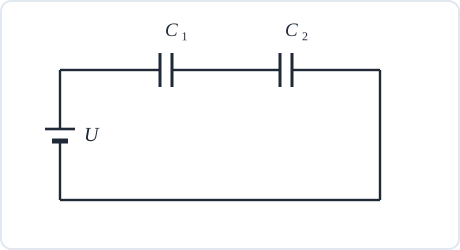
Given
- $C_1 = 2$ µF, $C_2 = 3$ µF
- $U = 100$ V
- $C = ?$, $q = ?$
- $U_1 = ?$, $U_2 = ?$
Hints
Hint
1 / 2
For capacitors in series the charge on both is the same and the voltages add up.
Hint
2 / 2
First find the capacitance of the combination $C = \frac{C_1 C_2}{C_1 + C_2}$ and the charge $q = CU$, then the voltages $U_1 = q / C_1$ and $U_2 = q / C_2$.
Solution
For capacitors in series the charge on both is the same (the middle section of the circuit is electrically isolated and stays neutral), and the voltages add up: $U = U_1 + U_2$.
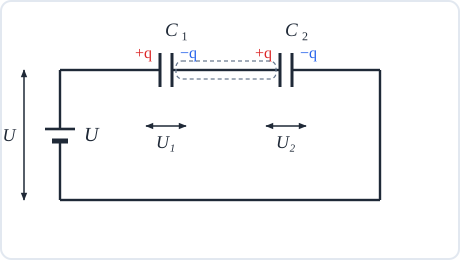
1. The capacitance of the combination:
$$\frac{1}{C} = \frac{1}{C_1} + \frac{1}{C_2} \;\Rightarrow\; C = \frac{C_1 C_2}{C_1 + C_2} = \frac{2 \cdot 3}{2 + 3} = 1.2 \text{ µF}$$2. The charge (the same on both capacitors):
$$q = CU = 1.2 \cdot 10^{-6} \cdot 100 = 1.2 \cdot 10^{-4} \text{ C} = 120 \text{ µC}$$3. The voltages:
$$U_1 = \frac{q}{C_1} = \frac{120}{2} = 60 \text{ V}, \qquad U_2 = \frac{q}{C_2} = \frac{120}{3} = 40 \text{ V}$$Check: $U_1 + U_2 = 100$ V $= U$. The larger voltage is across the capacitor of smaller capacitance.
Answer
$C = 1.2$ µF; $q = 120$ µC; $U_1 = 60$ V, $U_2 = 40$ V
Problems in this chapter
-
Charges of 2 uC and 3 uC are 0.1 m apart. Find the force between them
Medium
-
Two point charges of the same sign, 4 uC each, repel with a force of 9 N. Find the distance between them
Medium
-
A capacitor of capacitance 2 uF is charged to 100 V. Find the energy of the capacitor
Easy
-
A 2 g ball on a thread in a horizontal 10 kV/m field is deflected by 45°. Find the charge and the tension
Medium
-
Charges of 12 nC and 16 nC at the ends of 6 cm legs, a 1 nC charge at the right angle. Find the force on it
Medium
-
A 2.4·10⁻¹⁵ kg oil drop is in equilibrium between plates (d = 1 cm, U = 500 V). Find the charge of the drop and the number of electrons
Medium
Simulations in this chapter