Charge of an oil drop suspended between capacitor plates
An oil drop of mass $m = 2.4 \cdot 10^{-15}$ kg is in equilibrium between the horizontal plates of a parallel-plate capacitor. The distance between the plates is $d = 1$ cm, the voltage is $U = 500$ V, and the upper plate is positively charged (see the figure). Find the charge of the drop, determine its sign and the number of excess or missing electrons. The electron charge is $e = 1.6 \cdot 10^{-19}$ C, $g = 10$ m/s².
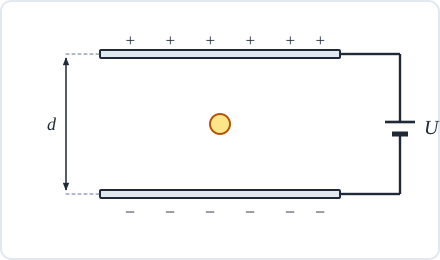
- $m = 2.4 \cdot 10^{-15}$ kg
- $d = 1$ cm $= 0.01$ m
- $U = 500$ V
- $e = 1.6 \cdot 10^{-19}$ C, $g = 10$ m/s²
- $q = ?$, $N = ?$
The drop is at rest, so gravity is balanced by the electric force. The field between the plates is uniform, $E = U/d$, and points from the positive plate to the negative one — downward. The electric force must point up, that is, against the field, so the charge of the drop is negative.
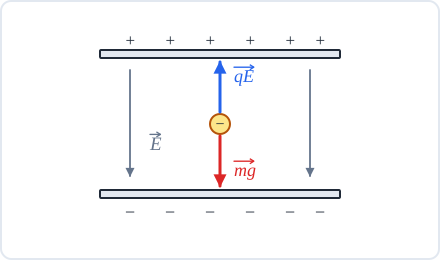
1. Equilibrium condition:
$$qE = mg \;\Rightarrow\; |q| = \frac{mg}{E} = \frac{mgd}{U}$$2. Substitute the numbers:
$$|q| = \frac{2.4 \cdot 10^{-15} \cdot 10 \cdot 0.01}{500} = 4.8 \cdot 10^{-19} \text{ C}$$3. The number of electrons:
$$N = \frac{|q|}{e} = \frac{4.8 \cdot 10^{-19}}{1.6 \cdot 10^{-19}} = 3$$The drop has an excess of three electrons.
$q = -4.8 \cdot 10^{-19}$ C (negative); an excess of three electrons
-
Charges of 2 uC and 3 uC are 0.1 m apart. Find the force between them
Medium
-
Two point charges of the same sign, 4 uC each, repel with a force of 9 N. Find the distance between them
Medium
-
A capacitor of capacitance 2 uF is charged to 100 V. Find the energy of the capacitor
Easy
-
A 2 g ball on a thread in a horizontal 10 kV/m field is deflected by 45°. Find the charge and the tension
Medium
-
Charges of 12 nC and 16 nC at the ends of 6 cm legs, a 1 nC charge at the right angle. Find the force on it
Medium
-
Capacitors of 2 µF and 3 µF are connected in series to 100 V. Find the charge and the voltage on each
Medium