Dispersion of Light in a Prism
Aim a narrow beam of white light at a glass prism and watch it split into a rainbow: violet rays are deviated more than red ones because the refractive index of glass depends on the wavelength. Rotate the prism, change its angle and material — from water to diamond, find the angle of minimum deviation, catch total internal reflection and repeat Newton’s two famous experiments: recombine the spectrum into white light and prove that a prism no longer splits a pure colour.
The rays are computed by ray tracing: the law of refraction acts at every face, and the weak reflected rays follow the Fresnel formulas. The running flashes are light pulses: in glass they move slower (v = c/n), and the violet ones fall behind the red ones. Dashed lines are the face normals and the continuation of the incident ray; the yellow arc is the deviation angle δ.
Model: n(λ) comes from Sellmeier formulas with catalogue coefficients (Schott glasses BK7, F2, SF11; water at 20 °C; diamond). White light is 40 wavelengths from 400 to 700 nm. Rays are traced in the plane of the drawing with the law of refraction and the Fresnel formulas; the screen is always perpendicular to the beam. The pulses show the travel time: their speed ∝ 1/n.
In 1666 Isaac Newton darkened a room, made a small hole in the shutter and placed a glass prism in the path of a sunbeam. On the wall, instead of a round white spot, an elongated coloured band appeared — a spectrum: red, orange, yellow, green, cyan, blue, violet. Newton realised that the prism does not “colour” the light but separates it: white light is a mixture of all colours, and glass refracts each colour differently. The dependence of the refractive index on the wavelength is called dispersion.
KEY FORMULAS
Law of refraction
α is the angle of incidence, β the angle of refraction (from the normal to the face); n₁, n₂ are the refractive indices of the media. Entering an optically denser medium, the ray bends towards the normal
Deviation of a ray by a prism
i₁ is the angle of incidence on the first face, i₂ the angle of emergence from the second, r₁ and r₂ the angles inside the glass, A the apex angle of the prism; δ is the angle between the incident and emergent rays
Refractive index from the minimum deviation
δmin is the minimum deviation angle: it is reached when the ray passes through the prism symmetrically (i₁ = i₂, inside parallel to the base)
Thin prism: deviation and spectrum width
For a prism with a small angle A (and not too oblique incidence) the deviation is proportional to A and (n − 1); the angular width of the spectrum Δδ is proportional to the difference of the indices for violet and red light
Speed and wavelength of light in a medium
c = 3·10⁸ m/s is the speed of light in a vacuum; in a medium light is n times slower, the frequency does not change at the boundary, so the wavelength also decreases n times
Critical angle of total internal reflection
If light falls from inside on the glass–air boundary at an angle larger than α₀, it does not come out but is totally reflected; α₀ ≈ 41° for crown glass, ≈ 38° for flint, ≈ 24° for diamond
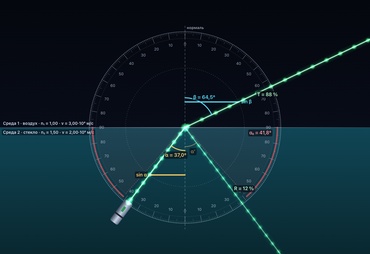
At the boundary between air and glass light refracts according to the law n₁·sin α = n₂·sin β. The refractive index n shows how many times slower light travels in a substance than in a vacuum: v = c/n. For glass n depends slightly on the wavelength: in flint glass n ≈ 1.615 for red light (656 nm) and n ≈ 1.651 for violet (405 nm). The larger n, the more the ray turns at each face. So violet rays are deviated the most, red ones the least, and behind the prism the white beam spreads into a fan. The n(λ) graph shows that n grows towards the violet end of the spectrum — this is normal dispersion.
A prism turns the ray twice — at the entrance and at the exit face — and both times towards the base. If i₁ is the angle of incidence, i₂ the angle of emergence and A the apex angle of the prism, the total deviation is δ = i₁ + i₂ − A, and the angles inside the glass satisfy r₁ + r₂ = A. Rotate the prism with the i slider and watch the δ(i) graph: the deviation first decreases and then grows again. The minimum deviation occurs for a symmetric path, when the ray inside the prism runs parallel to the base. Press “Find the minimum deviation” — and the spectrum on the screen stops and turns back. The refractive index is measured from δmin: n = sin((A + δmin)/2) / sin(A/2).
Compare the materials. Water has n ≈ 1.33 and little dispersion — the spectrum is narrow, less than a degree. Crown glass gives a spectrum about 1.4° wide, flint about 3.6°, dense flint almost 10°: flint glasses contain lead oxide, which strongly increases both n and its dependence on λ. Optical designers describe dispersion by the Abbe number V: the smaller it is, the more strongly the glass splits light. The width of the spectrum also grows with the apex angle: for a thin prism δ ≈ (n − 1)·A, so at A = 30° the deviation is about half that at 60°.
If the angle of incidence on the second face from inside exceeds the critical angle (sin α₀ = 1/n), light does not leave through it — total internal reflection occurs. For diamond n ≈ 2.42 and α₀ ≈ 24°, so a diamond prism with A = 60° does not let light out through the second face at any rotation. Reduce A to 30° — the light comes out and splits into a bright spectrum. The cut of a brilliant is designed exactly this way: light is reflected many times inside the stone and leaves it in multicoloured flashes — the “fire”.
Repeat Newton’s experiments. In the “Two prisms” mode an identical prism stands inverted behind the first one: it deviates each colour by the same angle in the opposite direction, and a white beam comes out again — so white light really is made of colours. In the “crucial experiment” a board with a narrow slit lets through only one colour. The second prism deviates it, but it does not split into new colours: a pure (monochromatic) colour is not a mixture. Switch on the light pulses — inside the glass they move slower and closer together, and the violet ones fall behind the red ones: dispersion is precisely the different speed of light of different colours in matter.
First come simulators and problems from this very chapter, then closely related topics of the section.
 Same topic
 Same topic
 Same topic
 Optics · Wave Optics
 Mechanics · Motion
 Mechanics · Energy