Radius of the light spot above a source in a liquid
A point source of light is at the bottom of a vessel, at a depth $h = 3$ m below the surface of a liquid with refractive index $n = 1.25$ (see the figure). A bright circle is seen on the surface of the liquid, outside of which no light leaves the liquid into the air. Find the radius $R$ of this circle. Take the refractive index of air to be 1.
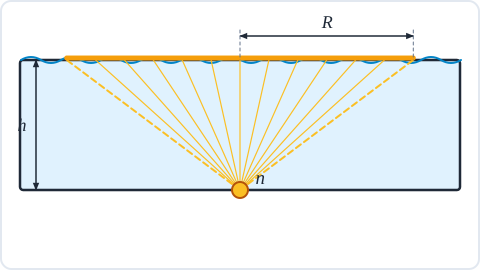
- $h = 3$ m
- $n = 1.25$
- $n_{air} = 1$
- $R = ?$
Rays that hit the surface at an angle larger than the critical angle $\theta$ undergo total internal reflection and do not leave the liquid. The edge of the bright circle is the point reached by the ray that hits the surface at the critical angle: the refracted ray grazes along the surface (angle of refraction $90°$).
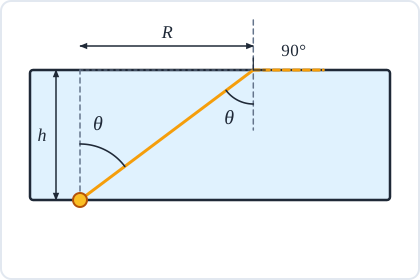
1. Snell's law for the critical angle:
$$n\sin\theta = 1 \cdot \sin 90° \;\Rightarrow\; \sin\theta = \frac{1}{n} = 0.8$$$$\cos\theta = \sqrt{1 - 0.8^2} = 0.6, \qquad \tan\theta = \frac{0.8}{0.6} = \frac{4}{3}$$2. In the right triangle with legs $h$ and $R$ the angle at the source is $\theta$:
$$R = h\tan\theta = 3 \cdot \frac{4}{3} = 4 \text{ m}$$$R = 4$ m