Ballistic pendulum: bullet speed and energy loss
A bullet of mass $m = 10$ g flies horizontally into a block of mass $M = 0.99$ kg hanging on two threads and embeds itself in it. The block with the bullet then swings up and rises by $h = 5$ cm (see the figure). Find the speed $v_0$ of the bullet and the fraction of its initial kinetic energy that turned into heat. Take $g = 10$ m/s².
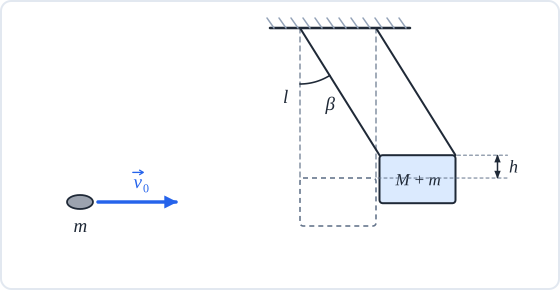
- $m = 10$ g $= 0.01$ kg
- $M = 0.99$ kg
- $h = 5$ cm $= 0.05$ m
- $g = 10$ m/s²
- $v_0 = ?$
- $Q/E_0 = ?$
The process has two stages: a fast inelastic collision (momentum of the system is conserved) and the rise of the block with the bullet (mechanical energy is conserved).
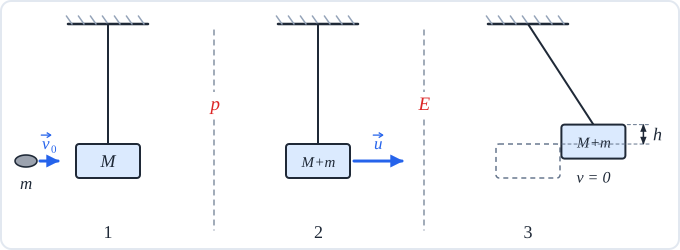
1. The rise. The kinetic energy right after the impact turns into potential energy:
$$\frac{(M + m)\,u^2}{2} = (M + m)\,g h \;\Rightarrow\; u = \sqrt{2gh} = \sqrt{2 \cdot 10 \cdot 0.05} = 1 \text{ m/s}$$2. The collision. Conservation of momentum (during the impact the threads do not act on the horizontal component):
$$m v_0 = (M + m)\,u \;\Rightarrow\; v_0 = \frac{(M + m)\,u}{m} = \frac{1 \cdot 1}{0.01} = 100 \text{ m/s}$$3. Energy before and after the collision:
$$E_0 = \frac{m v_0^2}{2} = \frac{0.01 \cdot 100^2}{2} = 50 \text{ J}, \qquad E_1 = \frac{(M + m)u^2}{2} = 0.5 \text{ J}$$The heat is $Q = E_0 - E_1 = 49.5$ J, so the fraction is
$$\frac{Q}{E_0} = \frac{49.5}{50} = 0.99 = 99\,\%$$$v_0 = 100$ m/s; $99\,\%$ of the energy turned into heat
-
Perfectly elastic collision of two bodies
Hard
-
A 1 kg ball hits a stationary 3 kg ball at 4 m/s. The collision is elastic. Find the speeds after the collision
Medium
-
A 2 kg ball moves at 3 m/s and collides with a stationary 1 kg ball. The collision is perfectly inelastic. Find the speed after the collision
Medium
-
Two bodies of mass 3 kg and 2 kg move towards each other at 4 m/s and 6 m/s. The collision is perfectly inelastic. Find the speed and direction after the collision
Medium