Ideal Gas Isoprocesses
A gas in a cylinder under a piston: heat it, squeeze it or lock it — and watch how pressure, volume and temperature change. Molecules fly and hit the piston and the walls, while the pressure gauge, the thermometer and three graphs show the same thing in numbers. Press “Run the process” — or take the sliders yourself.
Process graphs
The same process seen from three angles. The curve is the whole process, the yellow dot “2” is the current state, the grey ring “1” is the start. Name the process from the shape of the line — exactly how exam tasks ask it.
The main idea: a gas has three parameters — pressure p, volume V and temperature T — but only two are free. The third is fixed by the equation pV = νRT. An isoprocess is one in which one of the three is held constant, which is why there are three processes. Follow the coloured tags by the sliders: “constant” — the parameter is held, “you change” — you control it, “computed” — it adjusts by itself. The dashed line “1” in the scene shows where the process started.
KEY FORMULAS
The Mendeleev–Clapeyron equation
Equation of state of an ideal gas: pressure, volume and temperature are linked through the amount of substance and the gas constant
Isobaric process — Charles’s law
At constant pressure the gas volume is proportional to the absolute temperature
Isochoric process — Gay-Lussac’s law
At constant volume the gas pressure is proportional to the absolute temperature
Isothermal process — Boyle’s law
At constant temperature the pressure is inversely proportional to the volume
Gas work and the first law of thermodynamics
The heat supplied to a gas goes into the change of its internal energy and into the work done by the gas
Three quantities, but only two are free. The state of a gas is described by its pressure p, volume V and temperature T. They are linked by the Mendeleev–Clapeyron equation pV = νRT, where ν is the amount of gas in moles and R = 8.31 J/(mol·K). So only two of the parameters can be changed freely — the third adjusts by itself. If the amount of gas stays the same, this gives three simple laws: isobaric, isochoric and isothermal.
What “iso” means. The Greek prefix “iso-” means “equal”: isobaric — equal pressure, isochoric — equal volume, isothermal — equal temperature. In each process one parameter is held constant (in the simulator it is tagged “constant” and shown in amber), you control the second one (“you change” — blue), and the third is computed from the equation of state (grey, its slider is locked).
Why it works, at the level of molecules. Pressure is the impacts of molecules on the walls and the piston. The more frequent and the harder the impacts, the higher the pressure. The force of an impact grows with the molecule’s speed, and the mean speed grows as √T: heat the gas 4 times and the molecules fly twice as fast. The impact rate depends on how many molecules there are per unit volume: halve the volume and twice as many molecules share the same room. Together these two ideas give all three laws: the pressure is proportional to the number of molecules per unit volume and to T.
Isobaric process (p = const). The piston slides freely under a constant weight, so the gas pressure always equals the pressure of the weight. Heat the gas — the molecules speed up, push the piston and the gas expands: V/T = const. In English-language textbooks this is Charles’s law (Russian and Kazakh textbooks call it Gay-Lussac’s law). On the graphs: p–V — a horizontal line, V–T — a straight line through the origin, p–T — a horizontal line.
Isochoric process (V = const). The piston is locked, the gas has nowhere to expand, and heating speeds the molecules up: they hit the walls more often and harder, so the pressure rises: p/T = const (Gay-Lussac’s law in English-language textbooks, Charles’s law in Russian and Kazakh ones). On the graphs: p–V — a vertical line, V–T — a horizontal line, p–T — a straight line through the origin.
Isothermal process (T = const). The vessel sits in a thermostat (in the simulator — a water bath), the temperature is constant, so the molecular speed does not change. Only the volume changes: less room — more frequent impacts, higher pressure: pV = const (Boyle’s law). On p–V it is a hyperbola, on V–T and p–T — vertical lines.
Kelvins, not degrees. In the gas laws temperature is always absolute: T (K) = t (°C) + 273. Heating “from 27 °C to 327 °C” means 300 K → 600 K, i.e. twice, not 12 times. The most common exam mistake.
Work, energy and heat. When it expands, a gas does work A = p·ΔV — on the p–V graph this is the area under the curve (filled yellow in the simulator). For a monatomic gas (helium) the change of internal energy is ΔU = (3/2)·νR·ΔT, and the first law of thermodynamics Q = ΔU + A tells how much heat must be supplied. In isochoric heating A = 0: all the heat goes into ΔU. In an isothermal process ΔU = 0: all the heat turns into work, Q = A = νRT·ln(V₂/V₁). In an isobaric process part of the heat goes into work, so the same heating takes more heat: Q = (5/2)·νR·ΔT.
How to use the simulator. (1) Press “Run the process” and watch the chain “temperature → molecular speed → impacts → pressure or volume” work by itself. (2) Pick a process and take control: move the “you change” slider. (3) Press “Start counting here” and stretch the process: the “Measurements” tab checks the law (for example V₂/V₁ = T₂/T₁) and computes A, ΔU and Q. (4) Try “Experiments”: “Heat ×2” in the isobaric process raises the volume from 5 to 10 L. (5) Take the short quiz at the bottom of the page.
What the graphs show. The three graphs — p–V, V–T and p–T — show the process from three angles at once. The yellow dot is the current state “2”, the grey ring “1” is the start. Exam tasks often give a graph instead of a formula: from the shape of the line you must name the process and find a parameter. On V–T and p–T the dashed line continues the straight line to T = 0 K, which shows that the volume (or the pressure) is proportional to the absolute temperature.
Model assumptions. The gas is ideal: molecules are points that neither interact nor collide with each other. The amount of gas is constant (ν ≈ 0.30 mol); the scene shows 54 “molecules” for clarity — a symbolic scale, not the real number. The processes are quasi-static: slow enough for the gas to be in equilibrium at every moment. The molecular speed v rms = √(3RT/M) in the “Measurements” tab is computed for helium (M = 4 g/mol).
First come simulators and problems from this very chapter, then closely related topics of the section.
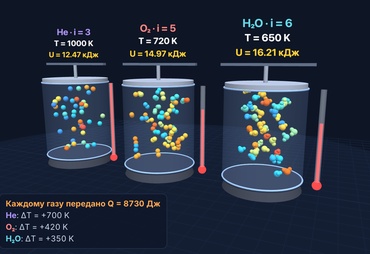 Molecular Physics and Thermodynamics · Internal Energy. Heat
 Mechanics · Motion
 Mechanics · Energy
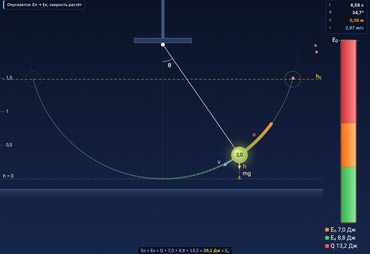 Mechanics · Energy
 Mechanics · Momentum
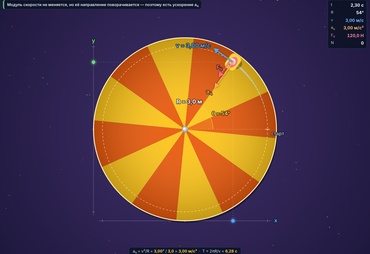 Mechanics · Circular Motion