Conical pendulum: thread tension and period
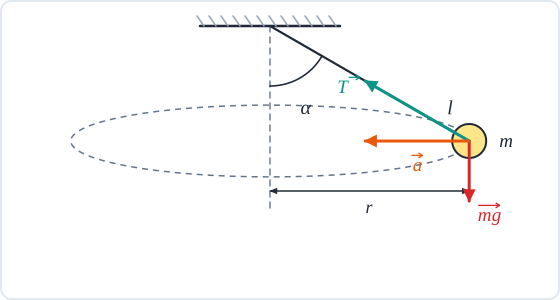
A ball of mass $m = 0.1$ kg hangs on a thread of length $l = 1$ m and moves uniformly in a circle in a horizontal plane. The thread makes an angle $\alpha = 60°$ with the vertical (see the figure). Find the tension $T$ in the thread and the period $\tau$ of the ball's revolution. Take $g = 10$ m/s².
- $m = 0.1$ kg
- $l = 1$ m
- $\alpha = 60°$
- $g = 10$ m/s²
- $T = ?$
- $\tau = ?$
The ball moves in a circle of radius $r = l\sin\alpha$ with a centripetal acceleration directed horizontally toward the axis. The forces on the ball are gravity and the thread tension.
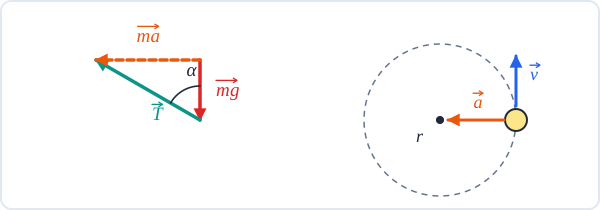
1. There is no vertical acceleration:
$$T\cos\alpha = mg \;\Rightarrow\; T = \frac{mg}{\cos\alpha} = \frac{1}{0.5} = 2 \text{ N}$$2. Horizontally, a component of the tension provides the centripetal acceleration $a = \omega^2 r$:
$$T\sin\alpha = m\omega^2 r = m\omega^2 l\sin\alpha \;\Rightarrow\; T = m\omega^2 l$$$$\omega^2 = \frac{T}{ml} = \frac{2}{0.1 \cdot 1} = 20 \;\Rightarrow\; \omega \approx 4.47 \text{ rad/s}$$3. The period:
$$\tau = \frac{2\pi}{\omega} = \frac{2 \cdot 3.14}{4.47} \approx 1.41 \text{ s}$$The general formula is $\tau = 2\pi\sqrt{\dfrac{l\cos\alpha}{g}}$ — the period does not depend on the mass of the ball.
$T = 2$ N, $\tau \approx 1.41$ s
-
Centripetal acceleration of a car
Easy
-
A car takes a turn of radius 50 m at 72 km/h. Find the centripetal acceleration
Easy
-
A disk rotates at 2 Hz around a circle of radius 0.5 m. Find the centripetal acceleration
Medium
-
A satellite orbits the Earth in a circular orbit of radius 10000 km. Find the linear speed (g on the orbit ≈ 4 m/s²)
Medium
-
A 1 t car drives at 36 km/h over a convex bridge of radius 40 m. Find the force on the bridge and the take-off speed
Medium
-
A block lies on a disk 0.2 m from the axis, μ = 0.5. At what angular velocity of the disk will it start to slip?
Medium