A car on a convex bridge: force on the bridge and take-off speed
A car of mass $m = 1$ t moves at a speed $v = 36$ km/h over a convex bridge of radius of curvature $R = 40$ m (see the figure). With what force does the car press on the bridge at its highest point? At what speed will the car stop pressing on the bridge at the top (lose contact with it)? Take $g = 10$ m/s².
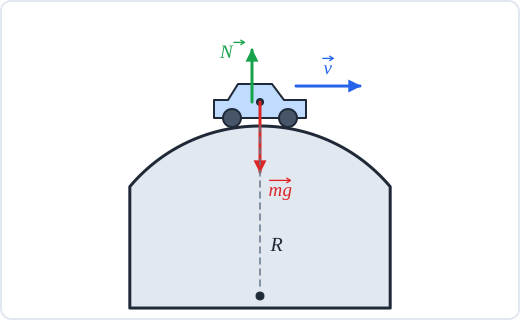
- $m = 1$ t $= 1000$ kg
- $v = 36$ km/h $= 10$ m/s
- $R = 40$ m
- $g = 10$ m/s²
- $N = ?$
- $v_{max} = ?$
At the top the car moves along an arc of radius $R$; its centripetal acceleration $a = v^2/R$ points downward, toward the center of curvature. The forces on the car are gravity $mg$ (downward) and the normal force $N$ from the bridge (upward).
1. Convert the speed: $v = 36$ km/h $= 10$ m/s. Newton's second law along the vertical (downward):
$$mg - N = m\frac{v^2}{R} \;\Rightarrow\; N = m\left(g - \frac{v^2}{R}\right) = 1000\left(10 - \frac{100}{40}\right) = 7500 \text{ N}$$By Newton's third law the car presses on the bridge with the same force: $7.5$ kN — less than the weight $mg = 10$ kN.
2. Contact is lost when $N = 0$:
$$mg = m\frac{v_{max}^2}{R} \;\Rightarrow\; v_{max} = \sqrt{gR} = \sqrt{10 \cdot 40} = 20 \text{ m/s} = 72 \text{ km/h}$$$N = 7.5$ kN; $v_{max} = 20$ m/s $= 72$ km/h
-
Centripetal acceleration of a car
Easy
-
A car takes a turn of radius 50 m at 72 km/h. Find the centripetal acceleration
Easy
-
A disk rotates at 2 Hz around a circle of radius 0.5 m. Find the centripetal acceleration
Medium
-
A satellite orbits the Earth in a circular orbit of radius 10000 km. Find the linear speed (g on the orbit ≈ 4 m/s²)
Medium
-
A 0.1 kg ball on a 1 m thread moves in a circle, the thread is 60° from the vertical. Find the tension and the period
Medium
-
A block lies on a disk 0.2 m from the axis, μ = 0.5. At what angular velocity of the disk will it start to slip?
Medium