A block on a rotating disk: the limiting angular velocity
A small block lies on a horizontal disk at a distance $r = 0.2$ m from the axis of rotation (see the figure). The coefficient of friction between the block and the disk is $\mu = 0.5$. The disk is spun up slowly. At what angular velocity $\omega$ will the block start to slip? Find the corresponding frequency of rotation $\nu$. Take $g = 10$ m/s².
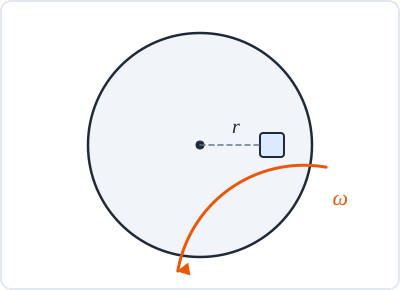
- $r = 0.2$ m
- $\mu = 0.5$
- $g = 10$ m/s²
- $\omega = ?$, $\nu = ?$
While the block is at rest relative to the disk, it moves along a circle of radius $r$ with a centripetal acceleration $a = \omega^2 r$ directed toward the axis. Only static friction provides this acceleration; vertically the forces $m\vec g$ and $\vec N$ balance.
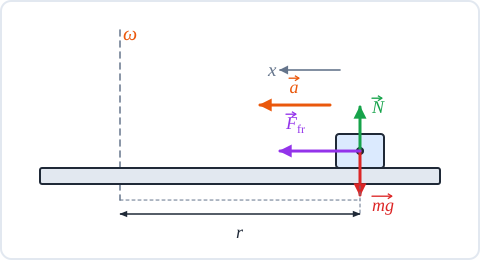
1. Vertically: $N = mg$. Horizontally (toward the axis): $F_{fr} = m\omega^2 r$.
2. Static friction cannot exceed $\mu N = \mu mg$. Slipping starts when it reaches its maximum:
$$m\omega^2 r = \mu mg \;\Rightarrow\; \omega = \sqrt{\frac{\mu g}{r}} = \sqrt{\frac{0.5 \cdot 10}{0.2}} = \sqrt{25} = 5 \text{ rad/s}$$3. The frequency of rotation:
$$\nu = \frac{\omega}{2\pi} = \frac{5}{2 \cdot 3.14} \approx 0.80 \text{ Hz} \quad (\approx 48 \text{ rpm})$$$\omega = 5$ rad/s; $\nu \approx 0.8$ Hz
-
Centripetal acceleration of a car
Easy
-
A car takes a turn of radius 50 m at 72 km/h. Find the centripetal acceleration
Easy
-
A disk rotates at 2 Hz around a circle of radius 0.5 m. Find the centripetal acceleration
Medium
-
A satellite orbits the Earth in a circular orbit of radius 10000 km. Find the linear speed (g on the orbit ≈ 4 m/s²)
Medium
-
A 1 t car drives at 36 km/h over a convex bridge of radius 40 m. Find the force on the bridge and the take-off speed
Medium
-
A 0.1 kg ball on a 1 m thread moves in a circle, the thread is 60° from the vertical. Find the tension and the period
Medium