Lorentz Force — 3D simulator | Physlabo
Loading...

Lorentz Force: a Charge in a Magnetic Field

When a charged particle moves in a magnetic field, the Lorentz force acts on it:
F = |q| · v · B · sin α
where q is the charge of the particle, v its speed, B the magnetic induction, and α the angle between the velocity and the field lines. This force is perpendicular to the velocity, so it does not speed the particle up — it only turns it.

Top view along B (x–z): a circle
Side view (z–y): a sine wave with pitch h

The idea in 30 seconds

1

The Lorentz force only turns

A magnetic field acts only on a moving charge, and the force is always perpendicular to the velocity — like the string you whirl a stone on. Such a force neither speeds the particle up nor slows it down: it changes the direction of the velocity, while the speed itself stays the same.

2

Split the velocity into two parts

Along the field lines no force acts — the particle simply flies steadily (v∥ = v·cos α). Across the field the force winds the motion into a circle (v⊥ = v·sin α). Steady motion along the field plus rotation across it make a spiral, like the thread of a screw. At α = 90° a pure circle remains, at α = 0° a straight line.

3

One turn does not depend on speed

A fast particle runs along a big circle, a slow one along a small circle, but one turn takes the same time: T = 2πm/(|q|B). As long as the field and the particle stay the same, the “clock” does not change. This is what the cyclotron, a particle accelerator, relies on.

Try it yourself

  1. Press “Circle”, “Spiral” and “Along the field” in turn and compare the path: the smaller the angle α, the steeper the spiral climbs, and at α = 0° only a straight line is left.
  2. The “v ×2” button: the radius doubles while the period does not change (watch the flash on the scene and the chart at the bottom right).
  3. The “B ×2” button: both the radius and the period halve — a stronger field bends the path harder. Watch the blue field lines get denser.
  4. Switch the electron to a proton. The charge is the same in size but the mass is 1836 times larger: the radius and the period are 1836 times larger too. (The picture is normalised — look at the numbers.)
  5. Press “E×B drift”: the electric field shifts the orbit sideways at E/B. Then set α = 0° — the particle flies straight through: this is a “velocity filter”.

Charts: why the period does not depend on speed

On the left are the components of the velocity vector: two waves shifted by a quarter of a period (the vector v⊥ rotates) and the flat line v∥. On the right is what happens when the speed changes: the radius grows in direct proportion, while the period stays equal to one.

Velocity components over two turns
Radius and period at different speeds (as fractions of the current ones)

Where you meet it

The polar auroraCharged particles of the solar wind wind around the lines of the Earth’s magnetic field and spiral down to the poles — that is where the atmosphere lights up.
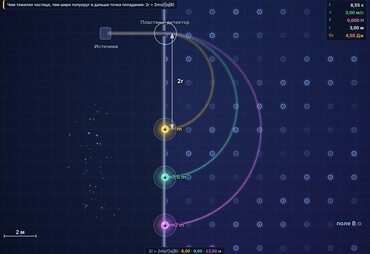
The mass spectrometerThe orbit radius r = mv/(|q|B) depends on the mass, so the spot where a particle hits the plate reveals its mass and separates isotopes — in chemistry, medicine and forensics.
The cyclotronThe period of revolution does not depend on speed, so the accelerating field can be switched at one fixed frequency — and the particle gets a fresh portion of energy turn after turn.
The cathode-ray tubeIn old TVs and oscilloscopes the electron beam is deflected by magnetic coils: the Lorentz force steers the beam to the right spot on the screen.
The fusion reactorIn a tokamak the hot plasma is held by a magnetic field: charged particles spiral around the field lines and do not reach the walls.
Experiments in one click
−
1,00 10⁶ m/s
60°
10 mT
5,0 kV/m
What happens if…
Playback speed
1×
Show

The numbers in the “Measurements” panel and on the board are real, in SI. The picture is normalised: the scale is chosen so that the turns fit the frame, and the pace so that one turn takes about 3 seconds (at B = 10 mT), so an electron and a proton look alike on screen although their real periods differ by thousands of times. When E is on, v⊥ is the speed of rotation relative to the drifting orbit.

A charged particle in a uniform magnetic field: a circle at α = 90°, a spiral at any other angle, and with a crossed field E ⊥ B a trochoid drifting at v_d = E/B. Rotate the scene with the mouse, change the speed, the angle and the induction — and see the formulas with your own numbers at once.

KEY FORMULAS

The Lorentz force

$$\vec{F} = q\,\vec{v} \times \vec{B}, \qquad F = |q|\,v_\perp B$$

The force is perpendicular to both the velocity and the field: it does no work and only turns the velocity

▶ Detailed Explanation
The Lorentz force is the cross product of the charge, the velocity and the magnetic induction: F = qv×B. By the definition of the cross product it is perpendicular to both factors — to v and to B — and therefore perpendicular to the particle’s displacement at every instant. Its work A = F·Δs·cos 90° = 0: the force can neither speed the particle up nor slow it down, it only turns the velocity vector continuously. The magnitude is F = |q|vB·sin α with α the angle between v and B; through the transverse component of the velocity it is F = |q|v⊥B. For motion along the field (α = 0) the force vanishes, for a perpendicular entry (α = 90°) it is maximal and plays the role of the centripetal force of the circle. The sign of the charge flips only the direction: for q > 0 the direction of the force follows the right-hand (corkscrew) rule for v×B, for q < 0 it is opposite, so electrons wind the opposite way to protons in the same field. In the school wording this is the left-hand rule: the B lines enter the palm, the four fingers point along the velocity of a positive charge, and the bent thumb shows the force. In the simulator this force is the red arrow — always perpendicular to the green velocity arrow.

Splitting the velocity into v∥ and v⊥

$$v_\parallel = v\cos\alpha, \qquad v_\perp = v\sin\alpha, \qquad F = |q|\,v\,B\sin\alpha$$

Along the field no force acts, across it the force winds the motion up; α is the angle between the velocity and the B lines

▶ Detailed Explanation
To make sense of the spiral it is convenient to split the velocity into two components relative to the field lines. Along B: v∥ = v·cos α. For it the cross product v∥×B is zero, so no force acts on it and v∥ stays constant — the particle moves steadily along the field. Across B: v⊥ = v·sin α. It gives the force F = |q|v⊥B = |q|vB·sin α, which is always perpendicular to v⊥ and turns it — the result is rotation along a circle. The two components move independently: the transverse motion does not disturb the longitudinal one and vice versa, so they simply add. The angle α = 90° means v∥ = 0, a pure circle; α = 0° means v⊥ = 0, a straight line. In the scene tick “Split v into v∥ and v⊥”: light-green arrows show both components, and on the “Velocity components” chart the flat dashed line is v∥ while the two waves are the rotating v⊥.

Orbit radius (Larmor radius)

$$r = \frac{m\,v_\perp}{|q|\,B}$$

The larger the transverse momentum, the wider the circle; the field and the charge squeeze it

▶ Detailed Explanation
The magnetic force never changes the speed, so the particle keeps moving along a circle at the constant speed v⊥, with the Lorentz force acting as the centripetal one: |q|v⊥B = m·v⊥²/r. Hence r = m·v⊥/(|q|·B) — the Larmor, or cyclotron, radius. The denominator holds the charge and the induction: the stronger the field and the larger |q|, the harder the path is bent and the smaller the radius. The numerator holds the momentum: a heavy or fast particle pushes the orbit outward. For comparison, in B = 10 mT an electron with v⊥ = 10⁶ m/s circles at about 0.6 mm, while a proton at the same speed needs about 1.0 m — the whole difference is the mass. In the simulator the scene scale is adjusted automatically so that a circle of any radius fits the frame, and the true value of r is always visible on the board and in the “Measurements” panel.

Period and frequency of revolution

$$T = \frac{2\pi m}{|q|\,B}, \qquad f = \frac{1}{T}, \qquad \omega = \frac{|q|\,B}{m}$$

The period depends neither on the speed nor on the radius — this is what a cyclotron relies on

▶ Detailed Explanation
The period of revolution is the circumference divided by the speed: T = 2πr/v⊥. Substituting the radius r = m·v⊥/(|q|·B) cancels v⊥: T = 2πm/(|q|·B). The speed has vanished from the result: however fast the particle flies and whatever the radius of its orbit, one full turn always takes the same time. This is the principle of the cyclotron — an accelerator whose driving frequency is constant because the particle’s period is constant too. The angular frequency ω = |q|B/m and the frequency f = 1/T are fixed solely by the charge-to-mass ratio and the field: for an electron |q|/m is about 1836 times that of a proton, so in the same field it winds up thousands of times faster — the electron period is measured in nanoseconds, the proton period in microseconds (at B = 10 mT: 3.6 ns and 6.6 µs). Try the “v ×2” and “B ×2” buttons: the period does not change with the speed, and is inversely proportional to the field. On the board the “1 s on screen” line shows how much the show is slowed down — that is why particles with different periods spin equally visibly on the scene.

Pitch of the spiral

$$h = v_\parallel T = \frac{2\pi m\, v_\parallel}{|q|\,B}$$

The distance along the field per turn: it grows as α decreases, at α = 90° there is no pitch — a circle

▶ Detailed Explanation
The component of the velocity along the field feels no force at all, so in one period T it carries the particle along the field by h = v∥·T — the pitch of the spiral, the distance between neighbouring turns. Substituting the period gives h = 2πm·v∥/(|q|·B). The pitch is proportional to v∥ = v·cos α: at α = 90° it is zero and the trajectory degenerates into a circle, while at α = 0° there is no transverse component at all and only a straight line along the field lines remains. The smaller α, the more the spiral unwinds. In the “Side” view the trajectory looks like a sine wave, and the distance between neighbouring crests is easy to measure and compare with h from the “Measurements” panel — the golden bracket in the panel marks one pitch. Note that the scene scale is normalised, so the spiral looks alike for different particles while the real h differ.

The magnetic force does no work

$$A = \vec{F}\cdot\Delta\vec{s} = 0, \qquad E_{\text{k}} = \frac{mv^2}{2} = \text{const}$$

The force is perpendicular to the displacement, so the speed and the kinetic energy do not change; only an electric field can speed the particle up

▶ Detailed Explanation
The work of a force over a small displacement Δs is A = F·Δs·cos β, where β is the angle between the force and the displacement. The particle’s displacement is along its velocity while the Lorentz force is perpendicular to the velocity, so β = 90°, cos β = 0 and the work is zero at every instant. By the work–energy theorem the work equals the change in the kinetic energy, so the kinetic energy E = mv²/2 and the speed are constant: a magnetic field changes only the direction of the velocity. This is the key difference from an electric field: there the force F = qE points along the field, does work and speeds the charge up. So when the field E ⊥ B is switched on in the scene, the speed and the kinetic energy on the board begin to oscillate — the energy is changed by the electric field, not by the magnetic one. And with E switched off, the |v| and Ek lines on the board stay constant however long the motion lasts.

Drift in crossed fields E and B

$$v_d = \frac{E}{B}, \qquad \vec{v}_d \perp \vec{E},\ \vec{v}_d \perp \vec{B}$$

With a crossed field E the particle slides sideways at E/B — a trochoid instead of a spiral

▶ Detailed Explanation
Add to the magnetic field an electric field perpendicular to it and the force qE starts acting as well. In a short time it accelerates the particle along E, then the magnetic force bends the trajectory back — cycle after cycle. Averaged over one period, the contributions of E and B balance, and the mean velocity turns out perpendicular to both fields: this is the drift velocity v_d = E/B. It does not depend on the charge, the mass or the sign — every particle drifts identically. The trajectory stops being a spiral and becomes a trochoid: the centre of rotation moves uniformly at v_d while the circle “rolls” around it. Per period the particle shifts by exactly v_d·T — that shift is what you measure in the “Side” view to read off the drift. The shape of the path depends on the ratio of v_d to v⊥: loops for v_d < v⊥, a cycloid with cusps for v_d = v⊥ (at the lowest point the particle stops for an instant), a wavy line for v_d > v⊥. If v⊥ = 0, the forces qE and q·v_d·B are equal and opposite: the particle flies straight — this is the principle of the “velocity filter”, which lets through only particles with speed E/B. In the scene try the “E×B drift” button and then set α = 0°.

What is going on. While a charge is at rest, a magnetic field “does not notice” it; as soon as the charge moves, the Lorentz force F = q·v×B acts on it. It points strictly perpendicular to the velocity and perpendicular to the field lines. Such a force neither pushes the particle forward nor slows it down — it only turns the velocity vector, like the string you whirl a stone on over your head. That is why the speed and the kinetic energy are not changed by a magnetic field: the work is A = F·Δs·cos 90° = 0.

Split the velocity into two parts. The angle α is the angle between the velocity and the field lines. The component along the field v∥ = v·cos α feels no force and stays constant: the particle steadily “drives” along B. The component across the field v⊥ = v·sin α gets wound up: the Lorentz force plays the role of the centripetal force, mv⊥²/r = |q|v⊥B. Add steady motion along the field to rotation across it and you get a spiral (a helix). At α = 90° a pure circle is left, at α = 0° a straight line: along the field lines the force is zero.

Radius, period and pitch. The radius r = m·v⊥/(|q|B): a heavy or fast particle draws a bigger circle, while a strong field and a large charge squeeze it. The period T = 2πm/(|q|B) does not depend on the speed — a fast particle runs round a big circle but takes the same time. The pitch h = v∥·T is the distance along the field in one turn. All these numbers with your values are shown on the board, in the “Measurements” panel and under the scene.

Which way the particle turns. The sense of rotation depends on the sign of the charge. Seen from above (looking against the B lines) a positive charge turns clockwise and a negative one counter-clockwise. The school left-hand rule: the B lines enter the palm, the four fingers point along the motion of a positive charge (against the motion for a negative one), and the thumb shows the force. An electron and a proton wind in opposite directions in the same field; the proton is 1836 times heavier, so its circle and its period are 1836 times larger too.

Crossed fields E and B. Add an electric field E ⊥ B and the force qE acts as well. The electric force pushes the particle sideways, the magnetic one winds it up, and on average there is a steady drift at v_d = E/B, perpendicular to both fields (it depends neither on the charge, nor on the mass, nor on the sign). The path is a trochoid: with loops when v_d < v⊥, a cycloid with cusps when v_d = v⊥, a wavy line when v_d > v⊥. Unlike the magnetic field, the electric field does work, so the speed of the particle oscillates. If v⊥ = 0 and the speed equals E/B, the forces qE and q·v·B cancel and the particle flies straight: this is how the “velocity filter” of a mass spectrometer works.

How to read the scene. The blue lines with little arrows are the magnetic field B (the denser, the stronger). The green arrow is the velocity v, the red one is the Lorentz force F: it always points to the centre of the circle. The “Along B” and “Side” buttons give viewpoints that match the two projections under the scene: a circle from above, a sine wave with pitch h from the side. The arrow lengths are schematic, while the numbers on the board are real. Real radii and periods of different particles differ by thousands of times, so the picture is normalised, and the “1 s on screen” line shows by how much time is slowed down.

Where you meet it. Polar auroras, the Earth’s radiation belts, mass spectrometers, cyclotrons and synchrotrons, cathode-ray tubes, the magnetic traps of fusion reactors, Hall sensors. Compare also with the simulator of a particle in a magnetic field (the flat version with a measuring grid and a mass spectrometer) and with the Ampère force.