Equilibrium of a current-carrying rod on inclined rails
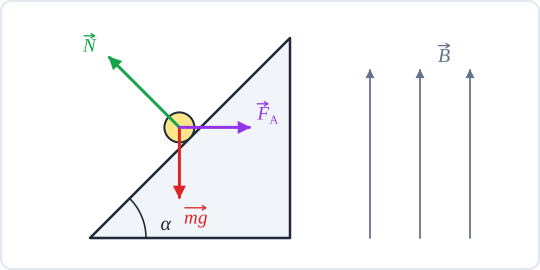
A horizontal rod of mass $m = 40$ g and length $L = 50$ cm lies on two smooth parallel rails inclined at an angle $\alpha = 45°$ to the horizontal. The system is in a uniform magnetic field with a vertical induction vector $B = 0.2$ T (the figure is a side view, the rod is shown as a circle). What current must flow through the rod to keep it in equilibrium, and in which direction: away from the observer into the plane of the figure, or toward the observer? Take $g = 10$ m/s².
- $m = 40$ g $= 0.04$ kg
- $L = 50$ cm $= 0.5$ m
- $B = 0.2$ T
- $\alpha = 45°$
- $g = 10$ m/s²
- $I = ?$
The forces on the rod are gravity $m\vec g$, the normal force $\vec N$ from the rails (perpendicular to the rails — there is no friction) and the Ampère force $\vec F_A$. The rod is perpendicular to $\vec B$ and $\vec B$ is vertical, so the Ampère force is horizontal with magnitude $F_A = BIL$.
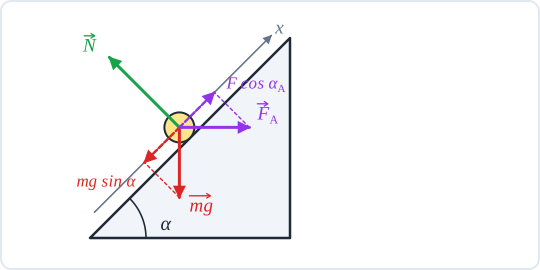
1. Equilibrium. Project the forces onto the axis along the rails ($N$ does not enter the equation):
$$F_A\cos\alpha - mg\sin\alpha = 0 \;\Rightarrow\; F_A = mg\tan\alpha$$2. Substitute $F_A = BIL$:
$$I = \frac{mg\tan\alpha}{BL} = \frac{0.04 \cdot 10 \cdot 1}{0.2 \cdot 0.5} = 4 \text{ A}$$3. Direction. To hold the rod, the Ampère force must point horizontally toward the slope (to the right in the figure). By the left-hand rule (the lines of $\vec B$ enter the palm, the thumb points along the force) the fingers must point away from the observer, into the plane of the figure.
$I = 4$ A; the current flows away from the observer, into the plane of the figure
-
A charge of 5 uC moves in a 0.2 T magnetic field perpendicular to the field lines at 10^4 m/s. The particle mass is 2e-5 kg. Find the radius of the circle
Medium
-
An electron enters a 0.01 T magnetic field at 2·10⁶ m/s perpendicular to the field. Find the period of revolution (m = 9.1·10⁻³¹ kg, q = 1.6·10⁻¹⁹ C)
Medium