Work and efficiency of a cycle on a p–V graph
A monatomic ideal gas performs the cycle $1 \to 2 \to 3 \to 4 \to 1$ shown on the $p$–$V$ graph (see the figure): $1 \to 2$ is isochoric heating, $2 \to 3$ isobaric expansion, $3 \to 4$ isochoric cooling, $4 \to 1$ isobaric compression. On the graph the pressure is given in units of $10^5$ Pa and the volume in litres. Find the work done by the gas per cycle and the efficiency of the cycle.
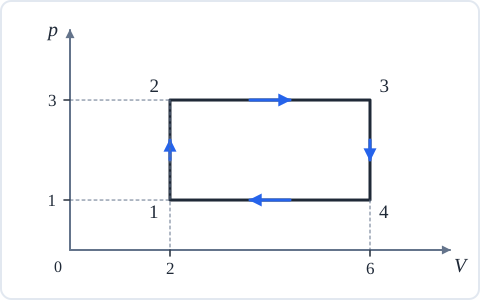
- $p_1 = 1 \cdot 10^5$ Pa, $p_2 = 3 \cdot 10^5$ Pa
- $V_1 = 2$ L $= 2 \cdot 10^{-3}$ m³
- $V_3 = 6$ L $= 6 \cdot 10^{-3}$ m³
- $A = ?$, $\eta = ?$
The work done by the gas per cycle is numerically equal to the area enclosed by the cycle on the $p$–$V$ graph (the cycle runs clockwise, so the work is positive). The efficiency is the ratio of this work to the heat received by the gas from the heater.
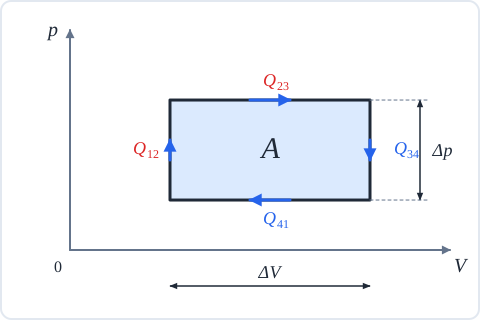
1. The work per cycle is the area of the rectangle:
$$A = (p_2 - p_1)(V_3 - V_1) = (3 - 1) \cdot 10^5 \cdot (6 - 2) \cdot 10^{-3} = 800 \text{ J}$$2. The gas receives heat while being heated — on stages $1 \to 2$ and $2 \to 3$. The internal energy of a monatomic gas is $U = \frac{3}{2}pV$. Isochore $1 \to 2$ ($A_{12} = 0$):
$$Q_{12} = \Delta U_{12} = \frac{3}{2}V_1(p_2 - p_1) = 1.5 \cdot 2 \cdot 10^{-3} \cdot 2 \cdot 10^5 = 600 \text{ J}$$Isobar $2 \to 3$:
$$Q_{23} = \Delta U_{23} + A_{23} = \frac{3}{2}p_2 \Delta V + p_2 \Delta V = \frac{5}{2}\,p_2 \Delta V = 2.5 \cdot 3 \cdot 10^5 \cdot 4 \cdot 10^{-3} = 3000 \text{ J}$$3. The heat received is $Q_+ = 600 + 3000 = 3600$ J. The efficiency of the cycle:
$$\eta = \frac{A}{Q_+} = \frac{800}{3600} \approx 0.22 = 22\,\%$$$A = 800$ J; $\eta \approx 22\,\%$