Weight of a person in an accelerating elevator
A person of mass $m = 70$ kg stands on the floor of an elevator cabin. The elevator moves with an acceleration $a = 2$ m/s² directed: 1) upward; 2) downward (see the figure). Find the weight of the person in each case. Take $g = 10$ m/s².
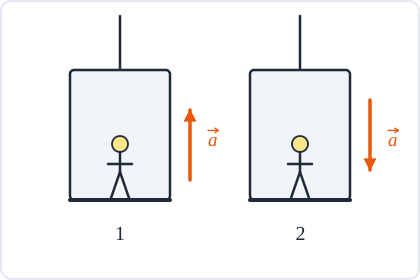
- $m = 70$ kg
- $a = 2$ m/s²
- $g = 10$ m/s²
- $P_1 = ?$, $P_2 = ?$
The weight $P$ is the force with which the person presses on the floor of the cabin. By Newton's third law it equals the normal force $N$ in magnitude, so it is enough to find $N$. The forces on the person are gravity $m\vec g$ (downward) and the normal force $\vec N$ (upward). Take the $y$ axis along the acceleration.
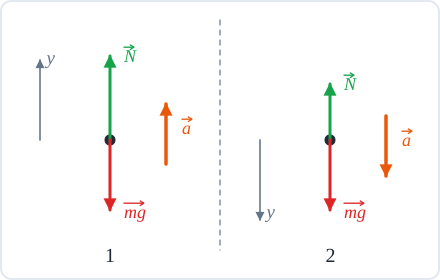
1. The acceleration points up:
$$N - mg = ma \;\Rightarrow\; P = N = m(g + a) = 70 \cdot (10 + 2) = 840 \text{ N}$$The weight is larger than gravity ($mg = 700$ N) — an overload.
2. The acceleration points down:
$$mg - N = ma \;\Rightarrow\; P = N = m(g - a) = 70 \cdot (10 - 2) = 560 \text{ N}$$The weight is smaller than gravity. At $a = g$ the weight would drop to zero — weightlessness.
1) $P = 840$ N; 2) $P = 560$ N
-
A block of mass 5 kg slides down a 30° incline, coefficient of friction 0.2. Find the acceleration
Medium
-
A force of 10 N acts on a body of mass 2 kg. Find the acceleration of the body
Easy
-
Two loads of mass 2 kg and 3 kg are connected by a string over a massless pulley (Atwood machine). Find the acceleration of the system
Medium
-
A load of mass 4 kg is lifted vertically upward with an acceleration of 2 m/s². Find the tension in the string
Easy
-
A 3 kg block on a table (μ = 0.1) is joined over a pulley to a 2 kg weight. Find the acceleration and the tension
Medium
-
A 4 kg block is pulled at constant speed up a 30° incline (μ = 0.3). Find the pulling force along the plane
Medium