A block on a table and a hanging weight over a pulley
A block of mass $m_1 = 3$ kg lies on a horizontal table and is joined by a light inextensible thread over a fixed pulley to a weight of mass $m_2 = 2$ kg (see the figure). The coefficient of friction between the block and the table is $\mu = 0.1$. Neglect the masses of the pulley and the thread and the friction in the pulley. Find the acceleration of the bodies and the tension in the thread. Take $g = 10$ m/s².
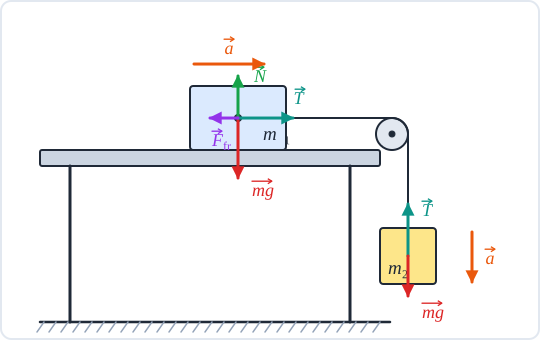
- $m_1 = 3$ kg
- $m_2 = 2$ kg
- $\mu = 0.1$
- $g = 10$ m/s²
- $a = ?$
- $T = ?$
The thread is inextensible and the pulley is massless and frictionless, so both bodies move with the same acceleration $a$ and the tension $T$ is the same along the whole thread. The block moves to the right, the weight goes down.
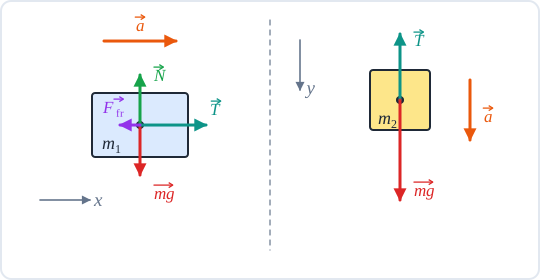
1. The block, axis along the table. Vertically $N = m_1 g$, so $F_{fr} = \mu m_1 g$:
$$m_1 a = T - \mu m_1 g$$2. The weight, axis downward:
$$m_2 a = m_2 g - T$$3. Add the equations — the tension cancels:
$$(m_1 + m_2)\,a = m_2 g - \mu m_1 g \;\Rightarrow\; a = \frac{m_2 g - \mu m_1 g}{m_1 + m_2} = \frac{20 - 3}{5} = 3.4 \text{ m/s}^2$$4. Find the tension from the equation for the weight:
$$T = m_2 (g - a) = 2 \cdot (10 - 3.4) = 13.2 \text{ N}$$Check with the block: $T = m_1 a + \mu m_1 g = 10.2 + 3 = 13.2$ N — correct.
$a = 3.4$ m/s², $T = 13.2$ N
-
A block of mass 5 kg slides down a 30° incline, coefficient of friction 0.2. Find the acceleration
Medium
-
A force of 10 N acts on a body of mass 2 kg. Find the acceleration of the body
Easy
-
Two loads of mass 2 kg and 3 kg are connected by a string over a massless pulley (Atwood machine). Find the acceleration of the system
Medium
-
A load of mass 4 kg is lifted vertically upward with an acceleration of 2 m/s². Find the tension in the string
Easy
-
A 4 kg block is pulled at constant speed up a 30° incline (μ = 0.3). Find the pulling force along the plane
Medium
-
A 10 kg block is pulled with a 50 N force at 30° above the horizontal (μ = 0.2). Find the acceleration
Medium