A block launched by a compressed spring over a rough floor
A block of mass $m = 0.5$ kg is pressed against a light spring of stiffness $k = 200$ N/m compressed by $x = 10$ cm; the block is not attached to the spring. The spring is released and the block moves along a horizontal floor with a coefficient of friction $\mu = 0.2$ (see the figure). Find the speed of the block at the moment the spring has returned to its natural length and the block leaves it, and the distance $s$ the block then travels before stopping. Take $g = 10$ m/s².
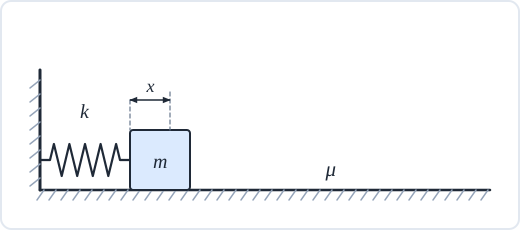
- $m = 0.5$ kg
- $k = 200$ N/m
- $x = 10$ cm $= 0.1$ m
- $\mu = 0.2$
- $g = 10$ m/s²
- $v = ?$
- $s = ?$
The motion has two stages: the block is accelerated by the spring (friction takes away part of the energy) and then slides by inertia until it stops. The block starts moving because $kx = 20$ N $> \mu mg = 1$ N. The work of friction $F_{fr} = \mu mg$ over a distance $l$ is $\mu mg\,l$.
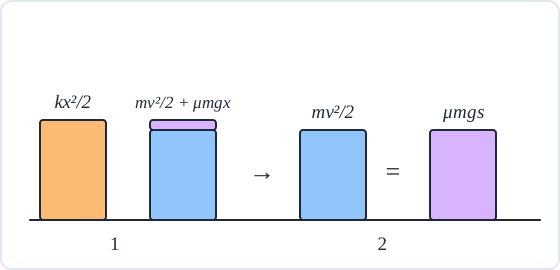
1. Stage 1 (distance $x$): the spring energy goes into kinetic energy and the work of friction:
$$\frac{kx^2}{2} = \frac{mv^2}{2} + \mu mg\,x$$$$v = \sqrt{\frac{kx^2 - 2\mu mg\,x}{m}} = \sqrt{\frac{200 \cdot 0.01 - 2 \cdot 0.2 \cdot 0.5 \cdot 10 \cdot 0.1}{0.5}} = \sqrt{3.6} \approx 1.9 \text{ m/s}$$2. Stage 2: all the kinetic energy goes into the work of friction:
$$\frac{mv^2}{2} = \mu mg\,s \;\Rightarrow\; s = \frac{v^2}{2\mu g} = \frac{3.6}{2 \cdot 0.2 \cdot 10} = 0.9 \text{ m}$$$v \approx 1.9$ m/s; $s = 0.9$ m
-
A 1 kg body slides down a 5 m slope without friction. Find the speed at the bottom
Easy
-
A pendulum of length 1 m is displaced 60° from the vertical. Find the speed at the lowest point
Medium
-
A block slides down a frictionless 2 m hill and then along a stretch with μ = 0.25. Find the speed at the bottom and the stopping distance
Medium