Speed at the bottom of a hill and stopping distance
A block slides without friction down a hill of height $h = 2$ m and then, passing smoothly onto a horizontal stretch, slides along it until it stops. The coefficient of friction on the horizontal stretch is $\mu = 0.25$ (see the figure). Find the speed of the block at the foot of the hill and the distance $s$ it travels along the horizontal stretch. Take $g = 10$ m/s².
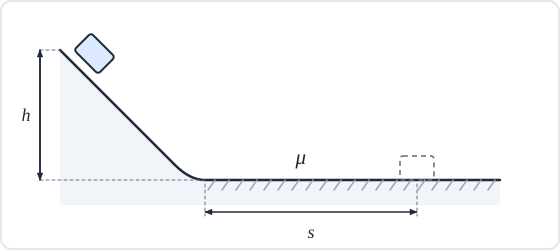
- $h = 2$ m
- $\mu = 0.25$
- $g = 10$ m/s²
- $v = ?$
- $s = ?$
There is no friction on the hill, so mechanical energy is conserved, while on the horizontal stretch all the kinetic energy goes into the work of friction. Compare three moments: $A$ — the top, $B$ — the foot, $C$ — the stop.
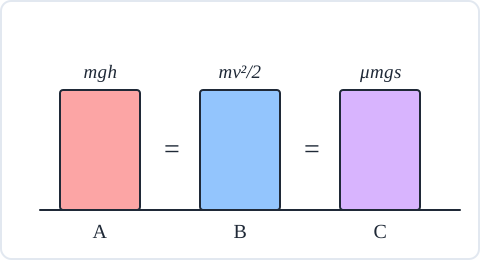
1. From $A$ to $B$ (energy is conserved):
$$mgh = \frac{mv^2}{2} \;\Rightarrow\; v = \sqrt{2gh} = \sqrt{2 \cdot 10 \cdot 2} = \sqrt{40} \approx 6.3 \text{ m/s}$$2. From $B$ to $C$ the kinetic energy turns completely into the work of friction $F_{fr} = \mu mg$ over the distance $s$:
$$\frac{mv^2}{2} = \mu mg\,s$$Or directly from $A$ to $C$: $mgh = \mu mg\,s$ — the mass cancels:
$$s = \frac{h}{\mu} = \frac{2}{0.25} = 8 \text{ m}$$$v \approx 6.3$ m/s; $s = 8$ m
-
A 1 kg body slides down a 5 m slope without friction. Find the speed at the bottom
Easy
-
A pendulum of length 1 m is displaced 60° from the vertical. Find the speed at the lowest point
Medium
-
A 0.5 kg block is released by a spring (k = 200 N/m, compressed 10 cm), μ = 0.2. Find the speed at release and the stopping distance
Medium