The Franck–Hertz Experiment: Quantized Atomic Energy
Accelerate electrons in a tube with mercury vapour or neon and record how the current depends on the voltage. The current grows, but every 4.9 V it drops sharply: electrons give mercury atoms exactly 4.9 eV each. Follow the energy of a single electron, find the current minima, and use the spacing between them to calculate the excitation energy of the atom and the wavelength of its light.
Move the U slider or press “Record I(U)”. Watch the yellow electron: once it gains the energy E₁, it hits an atom and loses it — and near the anode the retarding field turns the “tired” electrons back. Clicking the I(U) graph sets the tube to that voltage.
Model: the electron gains energy eU·x; while it is below E₁, collisions are elastic and hardly change its energy. At ε ≥ E₁ an inelastic collision happens after a random free path, and the electron loses E₁ (mercury: 4.89 eV, neon: ≈ 18.7 eV). The current is computed by a Monte Carlo method with the same rules. The contact potential difference is ignored, so the minima lie near k·E₁ + eUr; in a real tube the whole curve is shifted by 1–2 V, but the step ΔU is the same.
In 1914 James Franck and Gustav Hertz sent electrons through mercury vapour and saw that a mercury atom does not accept “any amount” of energy from an electron. While the electron has less than 4.9 eV, collisions are elastic — it bounces off, losing almost no energy. As soon as its energy reaches 4.9 eV, the atom takes all of it, goes into an excited state and soon emits an ultraviolet photon of 254 nm. That is why the current through the tube falls every time the accelerating voltage grows by another 4.9 V. It was the first direct proof that the energy of an atom is quantized.
KEY FORMULAS
Energy gained by an electron in the field
After passing an accelerating potential difference U, an electron with charge e gains kinetic energy eU; for U = 1 V this is 1 eV = 1.6·10⁻¹⁹ J
Excitation energy from the spacing of minima
ΔU is the spacing between neighbouring current minima on the I(U) curve; E₁ is the energy by which the atom is excited in an inelastic collision (4.89 eV for mercury)
Wavelength of light emitted by the excited atom
Returning to the ground state, the atom emits a photon of energy E₁; for mercury λ = 1240 eV·nm / 4.89 eV ≈ 254 nm — ultraviolet
Electron energy loss in an elastic collision
The largest fraction of energy a light electron of mass mₑ can transfer to an atom of mass M at rest in an elastic head-on collision; for mercury ≈ 1.1·10⁻⁵
A Franck–Hertz tube is a glass bulb with a cathode K, a grid G and an anode A, filled with mercury vapour (the bulb is heated in an oven to 150–200 °C so that the mercury evaporates). The hot cathode emits electrons, and the voltage U between the cathode and the grid accelerates them: at the grid an electron has gained the energy eU. A small retarding voltage Ur ≈ 1.5 V is applied between the grid and the anode. Only electrons that still have more than eUr at the grid reach the anode. An ammeter measures the current of these electrons.
On its way to the grid an electron collides with mercury atoms many times. If its energy is below 4.9 eV, the collision is elastic: a mercury atom is 370,000 times heavier than an electron, and the electron bounces off like a ball off a wall, losing about 0.001 % of its energy. But when the electron’s energy reaches 4.9 eV, an inelastic collision becomes possible: the atom takes exactly 4.9 eV and moves to its first excited level. It cannot take less — there are no lower levels. After about a hundred-millionth of a second the atom returns to the ground state and emits a 4.9 eV photon — the ultraviolet line at 253.7 nm.
This explains the shape of the current–voltage curve. While U < 4.9 V, the current grows. When U slightly exceeds 4.9 V, electrons gain 4.9 eV right at the grid, give it to atoms at once and reach the grid with almost no energy — the retarding field turns them back, and the current drops sharply. Further on, the electron has time to speed up again after the collision, and the current grows again until U reaches 2·4.9 V: now the electron hits atoms twice. This produces a series of minima ΔU = 4.9 V apart. In the simulator press “Record I(U)” and watch the energy of the yellow electron: at every collision it drops by 4.9 eV. The program finds the minima itself, measures ΔU and calculates E₁ = eΔU and λ = hc/E₁ — just as in a laboratory work.
Switch the gas to neon. The excitation energy of neon is about 18.7 eV, so the minima are ≈ 19 V apart. An excited neon atom gives its energy away in steps: first it emits a visible orange-red photon (585–703 nm), then an ultraviolet one. Where the electrons gain 18.7 eV and hit atoms, the gas glows — glowing layers are visible in the tube. At U ≈ 19 V there is one layer near the grid; as the voltage grows it moves towards the cathode, a second layer appears at ≈ 38 V and a third at ≈ 57 V. The number of layers is the number of collisions the electron has time to make.
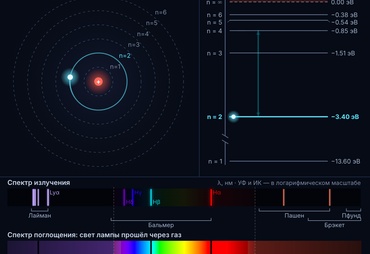
Try other settings too. If you remove the retarding voltage (Ur = 0), even electrons that gave their energy to atoms reach the anode, and the minima disappear. If you cool the oven, there is less mercury vapour, the electron flies further without collisions, and the dips become shallower. Franck and Hertz received the 1925 Nobel Prize for this experiment: it confirmed Bohr’s postulates — an atom can exist only in stationary states with definite energies and absorbs energy strictly in portions equal to the differences between those energies.
First come simulators and problems from this very chapter, then closely related topics of the section.
 Same topic
 Same topic
 Quantum Physics · Photoelectric Effect
 Quantum Physics · Thermal Radiation
 Quantum Physics · Radioactivity
 Mechanics · Motion
Section: Quantum Physics
All problems in this section (2)