Tensions in two threads supporting a load
A load of mass $m = 5$ kg hangs on two light threads attached to the ceiling. The threads make angles $\alpha = 37°$ and $\beta = 53°$ with the horizontal (see the figure). Find the tensions $T_1$ and $T_2$ in the threads. Take $g = 10$ m/s², $\sin 37° = \cos 53° = 0.6$, $\cos 37° = \sin 53° = 0.8$.
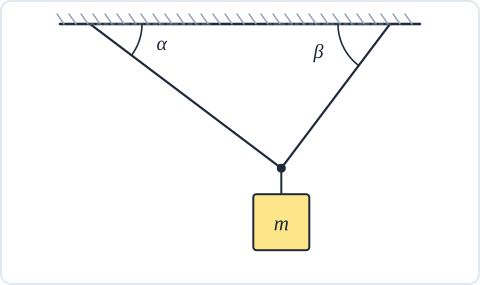
- $m = 5$ kg
- $\alpha = 37°$, $\beta = 53°$
- $\sin 37° = \cos 53° = 0.6$
- $\cos 37° = \sin 53° = 0.8$
- $g = 10$ m/s²
- $T_1 = ?$, $T_2 = ?$
The knot where the threads meet and the load hangs is in equilibrium, so the sum of the three forces ($m\vec g$, $\vec T_1$, $\vec T_2$) is zero. Take the $x$ axis horizontal and the $y$ axis vertically up, and project the forces.
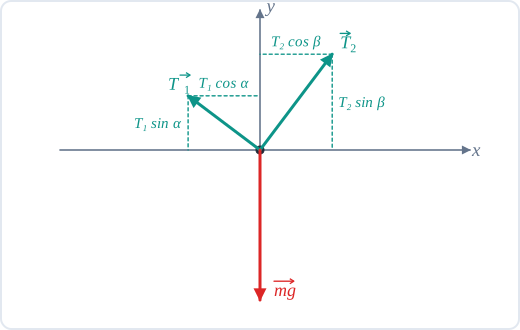
1. Horizontally (the horizontal components of the tensions are equal):
$$T_1\cos\alpha = T_2\cos\beta \;\Rightarrow\; 0.8\,T_1 = 0.6\,T_2 \;\Rightarrow\; T_2 = \frac{4}{3}\,T_1$$2. Vertically (the vertical components balance $mg = 50$ N):
$$T_1\sin\alpha + T_2\sin\beta = mg \;\Rightarrow\; 0.6\,T_1 + 0.8 \cdot \frac{4}{3}\,T_1 = 50 \;\Rightarrow\; \frac{5}{3}\,T_1 = 50$$$$T_1 = 30 \text{ N}, \qquad T_2 = \frac{4}{3} \cdot 30 = 40 \text{ N}$$Check. Since $\alpha + \beta = 90°$, the forces form a right triangle: $T_1 = mg\cos\beta = 30$ N, $T_2 = mg\cos\alpha = 40$ N.
$T_1 = 30$ N, $T_2 = 40$ N
-
A 0.2 kg ball on a thread is held 37° from the vertical by a horizontal force. Find the force and the tension
Medium
-
A uniform 20 kg beam, 6 m long, rests on two supports; a 60 kg load hangs 2 m from the left one. Find the support reactions
Medium
-
A uniform 10 kg ladder leans at 60° to the floor against a smooth wall. Find the floor friction and the wall reaction
Medium