A ladder against a smooth wall: friction and reaction forces
A uniform ladder of mass $m = 10$ kg and length $L$ leans against a smooth vertical wall and a rough floor, making an angle $\alpha = 60°$ with the floor (see the figure). Find the reaction force $N_w$ of the wall and the friction force acting on the ladder from the floor, as well as the minimum coefficient of friction of the floor for which the ladder does not slip. Take $g = 10$ m/s², $\tan 60° \approx 1.73$.
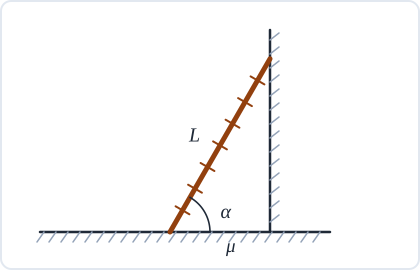
- $m = 10$ kg
- $\alpha = 60°$, $\tan 60° \approx 1.73$
- $g = 10$ m/s²
- $N_w = ?$, $F_{fr} = ?$, $\mu_{min} = ?$
The forces on the ladder are gravity $m\vec g$ at its midpoint, the wall reaction $\vec N_w$ (horizontal, since the wall is smooth), the floor reaction $\vec N$ (upward) and friction $\vec F_{fr}$ (along the floor, toward the wall) at the bottom point $O$. The ladder is in equilibrium: the net force and the net torque are zero.
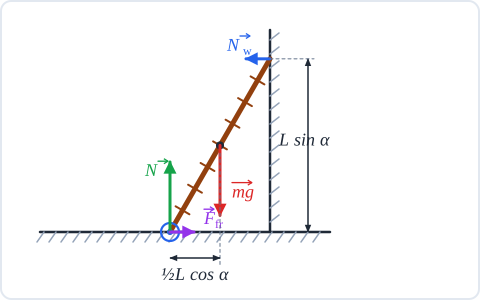
1. Vertical and horizontal forces:
$$N = mg = 100 \text{ N}, \qquad F_{fr} = N_w$$2. Torques about point $O$ (so $N$ and $F_{fr}$ drop out). The lever arm of gravity is $\frac{L}{2}\cos\alpha$, that of $N_w$ is $L\sin\alpha$:
$$N_w\,L\sin\alpha = mg\,\frac{L}{2}\cos\alpha \;\Rightarrow\; N_w = \frac{mg}{2\tan\alpha} = \frac{100}{2 \cdot 1.73} \approx 28.9 \text{ N}$$3. Friction is $F_{fr} = N_w \approx 28.9$ N. For the ladder not to slip we need $F_{fr} \le \mu N$:
$$\mu_{min} = \frac{F_{fr}}{N} = \frac{28.9}{100} \approx 0.29$$$N_w = F_{fr} \approx 28.9$ N; $\mu_{min} \approx 0.29$
-
A 0.2 kg ball on a thread is held 37° from the vertical by a horizontal force. Find the force and the tension
Medium
-
A uniform 20 kg beam, 6 m long, rests on two supports; a 60 kg load hangs 2 m from the left one. Find the support reactions
Medium
-
A 5 kg load hangs on two threads at 37° and 53° to the horizontal. Find the tensions in the threads
Medium