Loading...
Currents in a mixed resistor circuit
Problem statement
A resistor $R_1 = 4$ Ω is connected in series with two resistors $R_2 = 6$ Ω and $R_3 = 3$ Ω connected in parallel (see the circuit). A voltage $U = 24$ V is applied to the ends of the whole section. Find the current in each resistor and the voltage across $R_1$.
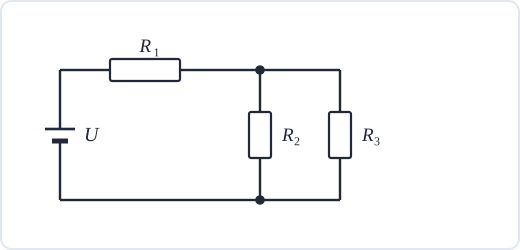
Given
- $R_1 = 4$ Ω, $R_2 = 6$ Ω, $R_3 = 3$ Ω
- $U = 24$ V
- $I_1, I_2, I_3 = ?$
- $U_1 = ?$
Hints
Hint
1 / 2
First find the resistance of the parallel group $R_{23} = \frac{R_2 R_3}{R_2 + R_3}$, then the total resistance of the section.
Hint
2 / 2
The current through $R_1$ equals the total current. The voltage across the parallel resistors is the same — find it as $U - U_1$.
Solution
First replace the parallel group by one equivalent resistor and find the total current; it flows through $R_1$ and then splits between $R_2$ and $R_3$. The voltages across parallel resistors are equal.
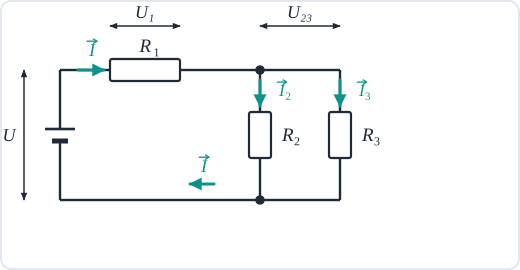
1. Resistance of the parallel group and of the whole section:
$$R_{23} = \frac{R_2 R_3}{R_2 + R_3} = \frac{6 \cdot 3}{6 + 3} = 2 \text{ Ω}, \qquad R = R_1 + R_{23} = 4 + 2 = 6 \text{ Ω}$$2. The total current is also the current through $R_1$:
$$I_1 = \frac{U}{R} = \frac{24}{6} = 4 \text{ A}, \qquad U_1 = I_1 R_1 = 4 \cdot 4 = 16 \text{ V}$$3. The voltage across the parallel group and the branch currents:
$$U_{23} = U - U_1 = 8 \text{ V}, \qquad I_2 = \frac{U_{23}}{R_2} = \frac{8}{6} \approx 1.33 \text{ A}, \qquad I_3 = \frac{U_{23}}{R_3} = \frac{8}{3} \approx 2.67 \text{ A}$$Check: $I_2 + I_3 = 4$ A $= I_1$.
Answer
$I_1 = 4$ A, $I_2 \approx 1.33$ A, $I_3 \approx 2.67$ A; $U_1 = 16$ V
Problems in this chapter
-
A 10 ohm resistor is connected to a 20 V source. Find the current
Easy
-
A current of 2 A flows through a 5 ohm conductor for 10 s. Find the quantity of heat
Easy
-
Two 6 ohm resistors are connected in parallel. Find the total resistance
Easy
-
Two 4 ohm resistors are connected in series. Find the total resistance
Easy
-
Find the power dissipated in a 20 ohm resistor carrying a current of 3 A
Easy
-
Three 2 ohm resistors are connected in parallel. Find the total resistance
Easy